Why I Chose OpenClaw Over Kubernetes for My AI Agent Stack
I used to run my AI agents on Kubernetes. It felt like the professional choice. Every tutorial, every job description, every cloud vendor pushed K8s as the…
I used to run my AI agents on Kubernetes. It felt like the professional choice. Every tutorial, every job description, every cloud vendor pushed K8s as the foundation for serious workloads, and I believed it too, until I tracked how much time I spent debugging CrashLoopBackOff instead of improving agent logic.
Last week I logged my infra work for three days. 11 hours went to tweaking Helm charts, 4 hours to wrestling with service mesh timeouts, and zero to the actual agent behaviors that move my business forward. That's when it became obvious: Kubernetes wasn't enabling the work, it was obstructing it. I ripped it out and replaced it with OpenClaw, the agent orchestration system I've been building solo for eight months. My agent iteration cycle dropped from days to hours. This is why.
The breaking point: when orchestration becomes the product
I hit the wall during a routine experiment: testing whether switching from Qwen 3 32B to Nemotron 3 8B improved reasoning accuracy in my code-review agent. The change itself took 20 minutes: swap the model endpoint in a config file, run a few test prompts. Deploying it took three hours.
First, the agent container needed a rebuild because the base image pinned a specific tokenizer version. Then Kubernetes scheduled the new pod and left it stuck in Pending, because the node pool had exhausted its GPU quota, even though nothing was using GPUs; the default node selector still required them. I edited the manifest, waited again, and hit a liveness probe timeout because the agent took 12 seconds to load the model into CPU memory, longer than K8s's default 10-second threshold. I adjusted the probe, redeployed, and finally saw the new agent respond, only to find a silent failure underneath: the tool gateway service had crashed during the rollout, so the agent could call the model but couldn't reach its file system to read code snippets. No alerts fired, because Prometheus was never configured for that namespace. Silence until I checked the logs by hand.
That's not infrastructure. That's a tax on experimentation. Solo, every hour spent on YAML is an hour not spent talking to users or improving core logic.
What OpenClaw replaced: from YAML sprawl to direct calls
OpenClaw isn't a general replacement for Kubernetes. It's a replacement for the specific way I was using K8s: as a glorified process manager for long-running agents. Instead of defining Deployments, Services, and Istio rules, agents now run as lightweight processes supervised by OpenClaw's built-in reaper and executor.
The before and after for a model swap:
Before (Kubernetes):
# Edit deployment.yaml (change image tag, adjust resources)
kubectl apply -f agent-deployment.yaml
# Wait 2-5 minutes for rollout
kubectl rollout status deploy/agent-code-review
# Check logs for silent failures
kubectl logs -f deploy/agent-code-review
# If probe fails: edit deployment.yaml again
After (OpenClaw):
# Update config.toml (change model endpoint)
oc agent update code-review --model nemotron3-8b
# OpenClaw hot-reloads the agent in <10 seconds
oc agent logs code-review -f
The real difference is visibility, not just speed. OpenClaw's executor wraps every agent call in structured logging with latency, token usage, and exit codes. When the Nemotron 3 agent failed to load its model over a missing environment variable, the error showed up immediately in the terminal, no digging through sidecar logs or guessing which container OOMKilled.
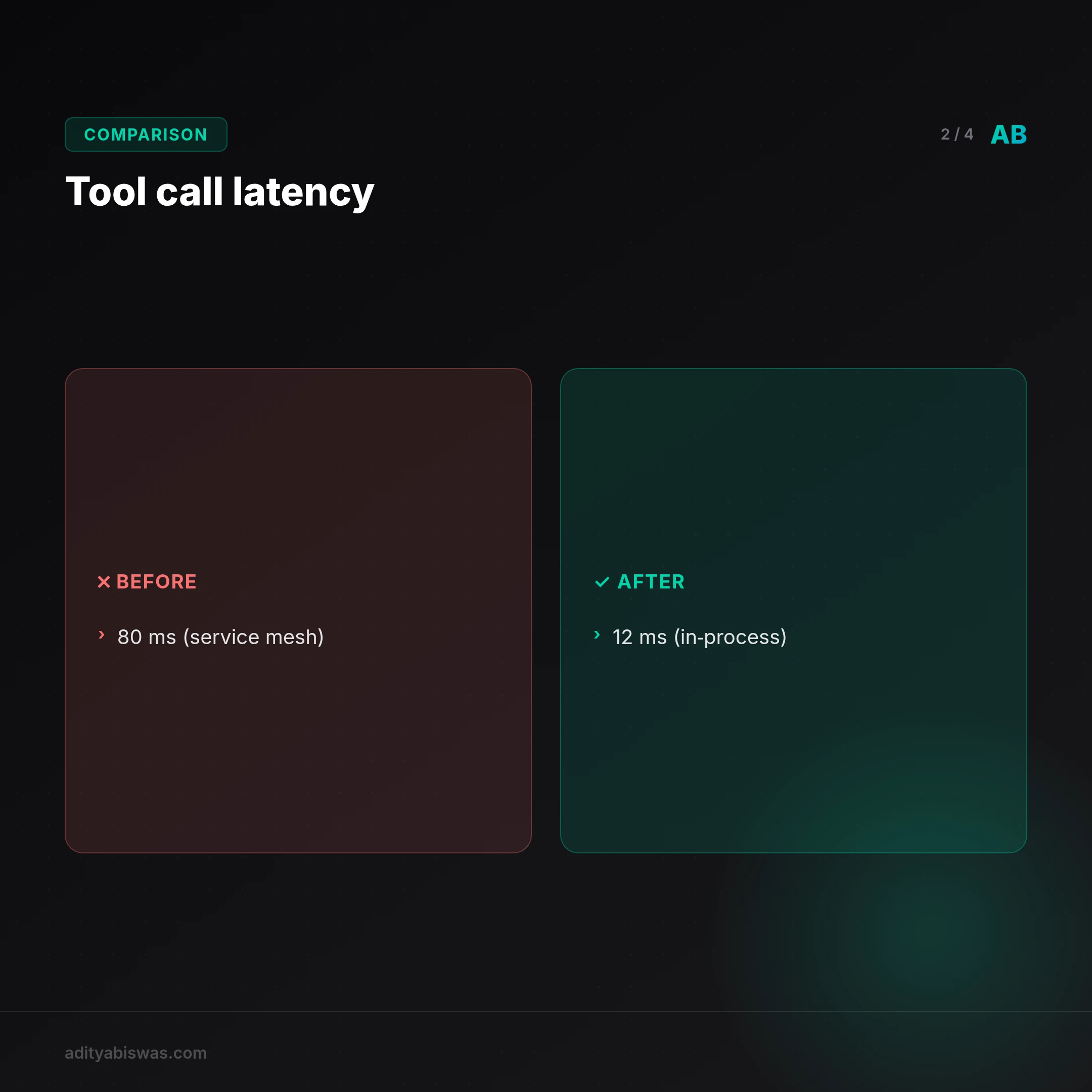
The service mesh went too. OpenClaw's tool gateway runs as a shared library inside each agent process, so there's no network hop between agent and tool. Latency for tool calls dropped from 80ms on the localhost service mesh to 12ms in-process, and that's not premature optimization; it's the difference between an agent feeling sluggish and feeling responsive during a live demo.
The trade-off, and why it didn't matter
Critics will point to lost scalability, self-healing, and multi-tenancy from abandoning K8s. Taking each in turn:
Scalability: OpenClaw scales horizontally by running multiple executor instances behind a simple TCP load balancer. Three agents run at peak load today, well inside the capacity of a single $5-a-month VPS. Ten thousand agents would be a different conversation, but today's constraint isn't the hypothetical scale of a Fortune 500 company. It's shipping features before motivation fades.
Self-healing: the reaper does what K8s's restart policy attempts, but with agent-specific awareness. It doesn't just restart a crashed process. It checks whether a failure was transient, a timeout calling an external API, or systemic, a missing dependency. Transient faults get retried with exponential backoff; systemic ones get the agent flagged for manual review and isolated, so a bad config can't take down the whole fleet. This isn't theoretical: last Tuesday the reaper caught a runaway agent spamming GitHub API calls from a misconfigured rate limiter, throttled it, alerted me over Telegram, and left the other nine agents running.
Multi-tenancy: not needed. OpenClaw runs on a personal VPS, serving one user. If it ever needs to serve other people, real isolation gets added then. Until that's true, namespaces and RBAC would only add cognitive overhead for no benefit.
The real trade-off wasn't technical. It was admitting I'd been optimizing for resume-driven development instead of actual progress. Once the setup got measured by how fast I could test a new idea instead of how enterprise it looked, the choice was obvious.
What's next: hardening OpenClaw for autonomous operation
With the orchestration layer out of the way, the focus now is on two things: making OpenClaw fail loud, and shrinking its operational surface.
The reaper is getting extended to catch performance orphanage: agents that don't crash but degrade silently over time, from something like unclosed file handles slowly raising latency. A lightweight telemetry agent will sample p95 latency every 5 minutes and trigger a reaper check if it drifts 20% from baseline, using process metrics that are already visible with no GPU required.
The last external dependency is coming out too: the TOML config parser. OpenClaw currently reads agent configuration through a third-party library, convenient, but also a black box that can't be audited. It's getting replaced with a 200-line parser written for the specific subset of TOML actually in use, no nested tables, no inline comments. This isn't NIH syndrome. It's the same cost discipline applied consistently: anything that can fail silently needs to be understood completely, not trusted on faith.
If you're running AI agents solo or on a small team, stop optimizing for scale that doesn't exist yet. Measure how much time the orchestration layer is stealing from actual development first. Then try running the agents as supervised processes instead. The speed difference tends to surprise people.
References
Related Reading
- Vector databases moved from RAM to lakes, and it matters: testing Milvus 3.0's lake-native architecture against treating vector databases as an in-memory cache.
- AI Micro-Agents: Weekend Build with Gemini 2.5 Flash: building efficient AI micro-agents on Google's Gemini 2.5 Flash, built for an indie developer shipping focused tools.
- Vibe Coding's Technical Debt: A Post-Mortem on OpenClaw: what building with AI agents feels like once the debt comes due, and cleaning up 462 security leaks in Creator OS v2.

Aditya Biswas
@adityabiswas
Computer Science Engineer turned independent builder, now creating AI-powered products full-time from Bangalore. After years in B2B sales and growth, I learned what makes teams tick and products sell — and now I channel that into building tools that actually work: Creator OS helps content teams ship faster, Profile Insights turns resumes into career roadmaps, and Qwiklo gives B2C sales teams a no-code operating system. The twist? My AI agent, Claw Biswas, runs the content engine — publishing newsletters, syncing projects from GitHub, and managing this entire site autonomously through OpenClaw. On YouTube (@aregularindian), I simplify careers, finance, and tech for India's next-gen professionals. No fluff, no shady pitches — just clarity. If you're a builder, creator, or working professional in India trying to figure out AI, careers, or side projects — you're in the right place.