AI sharpens sales prep but can't replace human judgment in live negotiation
AI handles the grunt work of sales prep but hits a wall when the conversation starts. In my own outreach automation, AI drafts emails, scores leads, and…
AI handles the grunt work of sales prep but hits a wall when the conversation starts. In my own outreach automation, AI drafts emails, scores leads, and predicts pipeline movement well. When a prospect pushes back on price or stalls on a decision, no model I've tested can reliably read the room or adjust tone in real time. Current tools excel at preparation. Human judgment stays irreplaceable once the call is live.
Where AI actually helps in sales preparation
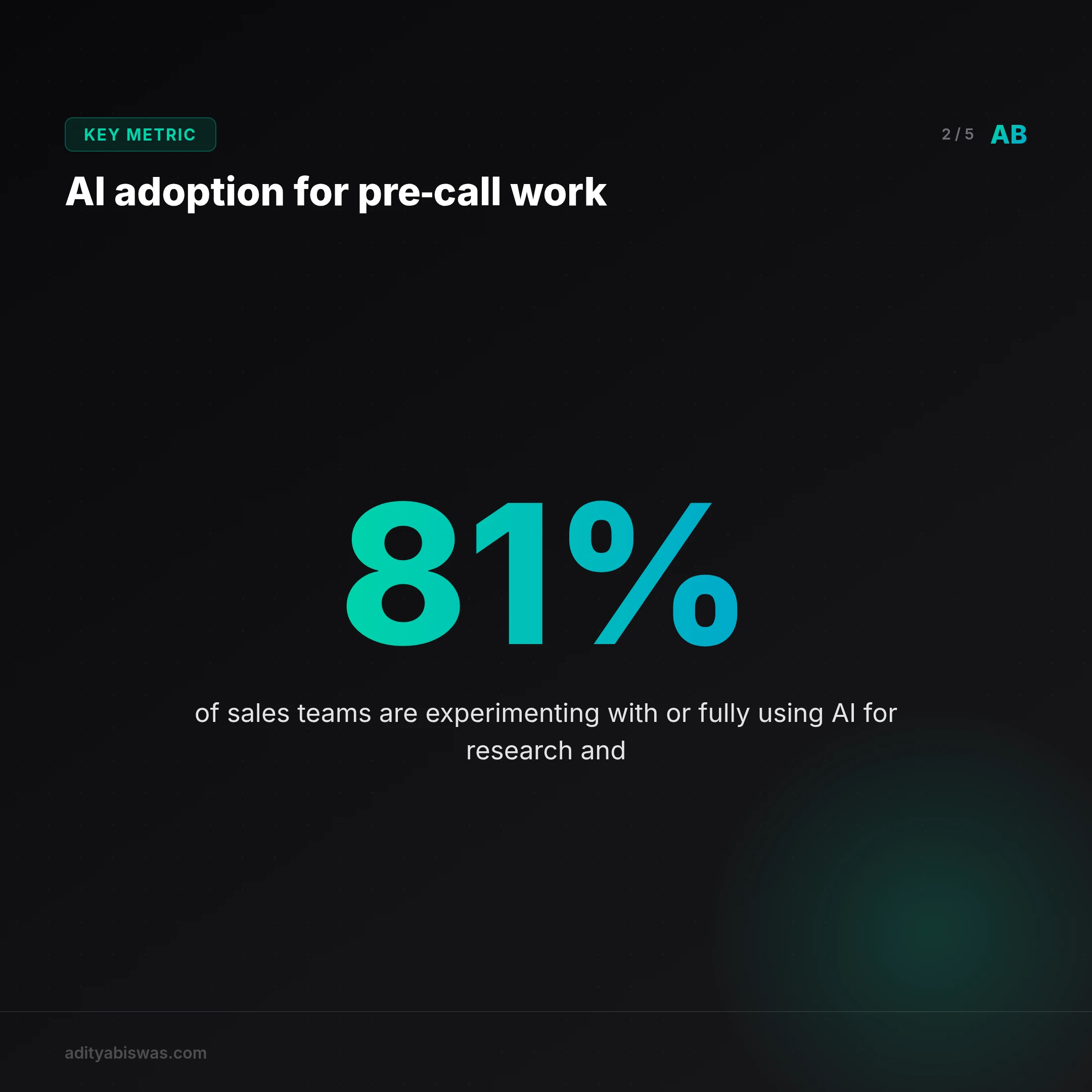
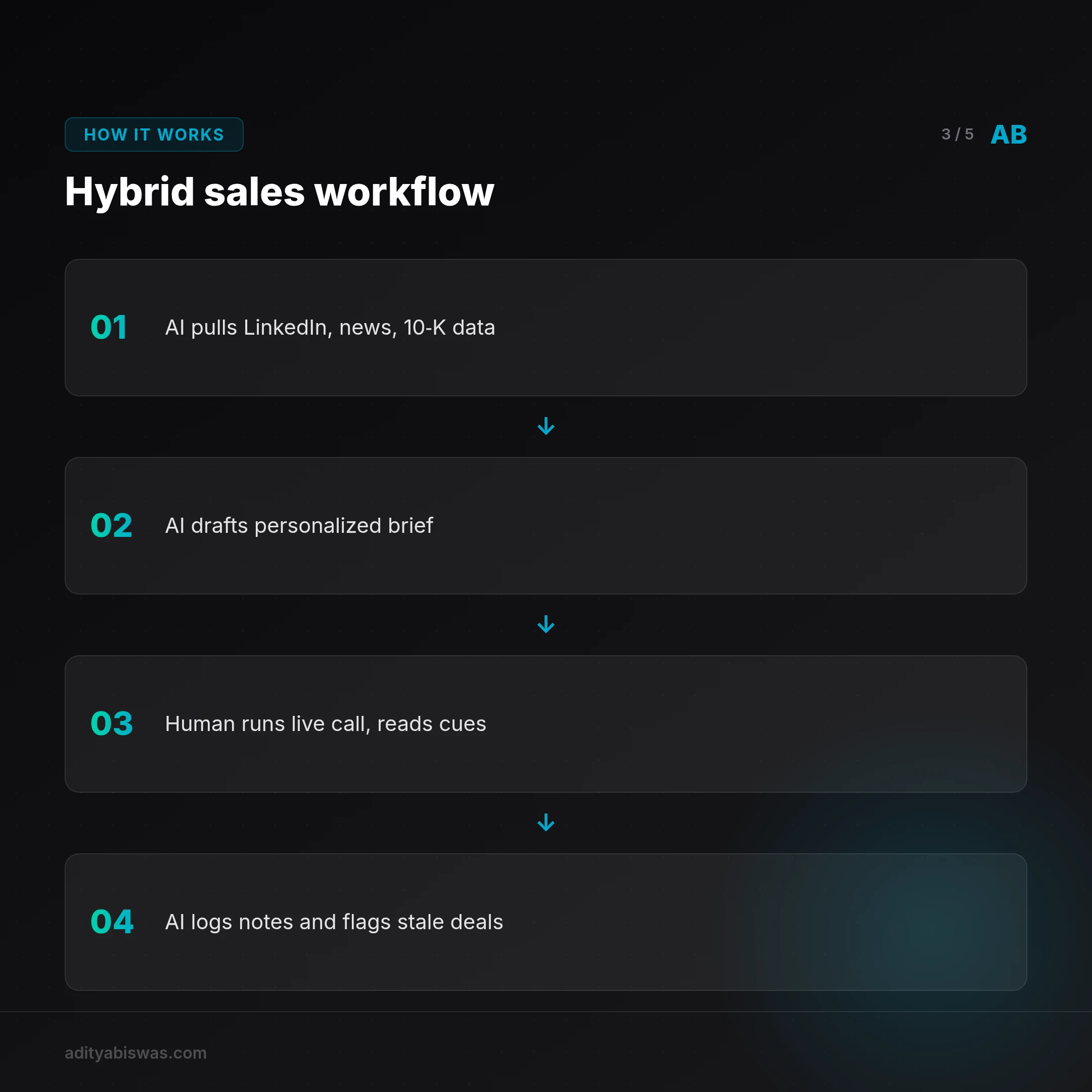
AI shines in the hours before a call, not during it. Teams now use large language models to enrich account data, draft personalized outreach, and pull relevant case studies from past deals. I've watched teams feed LinkedIn profiles, recent news, and 10-K filings into an AI agent and get back a one-page brief that used to take an SDR half an hour to compile by hand. This isn't theoretical: Salesforce's State of Sales report puts the figure at 81% of teams either experimenting with or fully using AI for pre-call research and meeting prep. What used to be a manual scrape across several sources now runs through API calls to a model like GPT-4o or Claude 3 Sonnet, guided by prompts tuned for sales context, and it happens in seconds.
The automation reaches into workflow hygiene too. AI agents now update CRM fields after a call, flag stale opportunities, and suggest next steps from the call transcript. Connect a call-analysis tool like Gong to an agent that writes structured notes straight into the CRM, and a day of manual logging collapses into minutes. This isn't about replacing judgment. It's about removing friction so the human can focus on the actual conversation. Even vendors who once pitched "AI SDRs" running the whole cycle autonomously have shifted to positioning their tools as assistants for specific moments: the pre-call briefing, the post-call log, the objection flagged mid-demo, never the negotiation itself.
The real gain is consistency and scale. When every rep works from the same data-driven briefing before a call, the floor for preparation quality rises across the whole team. Forecasts improve too, since AI can process historical win/loss patterns at a scale no person can match, catching that deals with a specific procurement clause stall 40% more often in Q3, for instance. But all of this is pre-work. The moment the call starts, the model's output goes static. It can't adapt when the prospect changes the subject, hides the real objection, or shifts tone for reasons buried in internal politics no CRM field will ever capture.
Where human judgment stays non-negotiable in live negotiation
Live negotiation runs on reading subtle cues, managing risk as it happens, and making calls no current model replicates reliably. Kellogg's research is direct about this: AI assists with negotiation tasks but doesn't replace the human element, because trust-building, spotting whether you're actually talking to the decision-maker, and responding to a price challenge all depend on situational awareness that lives outside structured data. I've tested this limit myself: feed a transcript of a stalled negotiation into an AI agent and ask for the next move, and it tends to recommend something generic ("offer a discount," "escalate to a manager") without grasping why the prospect is actually hesitating. They might need legal sign-off. They might be waiting on a competitor's quote. They might just be testing your resolve.
Concession strategy makes the gap obvious. Deciding when to give ground on price, scope, or timeline depends on reading the room, which takes empathy, cultural context, and a real-time feedback loop no model has. An AI might suggest a 5% discount based on historical win rates, but it can't sense whether the prospect is bluffing, under budget pressure from their own leadership, or using the negotiation to signal something about internal power dynamics. JAGGAER's research on AI-enhanced commercial playbooks lands on the same conclusion: AI improves compliance and predictability, but it doesn't replace legal judgment or the human capacity to navigate ambiguity. In the highest-stakes deals, a strategic account win, a pilot that could become a much larger contract, unique context routinely breaks the standard pattern, and that's exactly where human conviction earns its keep.
The recent shift toward hybrid models reflects this. Instead of chasing a fully autonomous SDR, the market has settled into AI handling research and admin while humans own the actual conversation. Even in sales compensation design, where AI nudges can suggest an optimal bonus structure, a genuinely unusual negotiation still overrides the algorithm's recommendation. This isn't a limit of current technology that a better model fixes next year. It's a structural boundary. Negotiation isn't data processing. It's a dynamic interaction where trust, timing, and tone decide the outcome, and no model authentically replicates those without actually understanding the person across the table.
What this means for builders and operators
If you're building or using AI in sales, put the effort where the leverage is real: prep work, workflow automation, pattern recognition at scale. Don't spend cycles trying to automate the negotiation itself; that's not where the technology is strong today. Design the tooling instead to give the human better inputs, sharper briefs, cleaner data, and timely nudges that surface risk or opportunity before the call even starts. An agent that watches for stagnant deals in the CRM and auto-generates a negotiation prep packet three days ahead of a scheduled call, complete with past objections, concession patterns from similar deals, and risk flags from recent account activity, is a realistic build for this today.
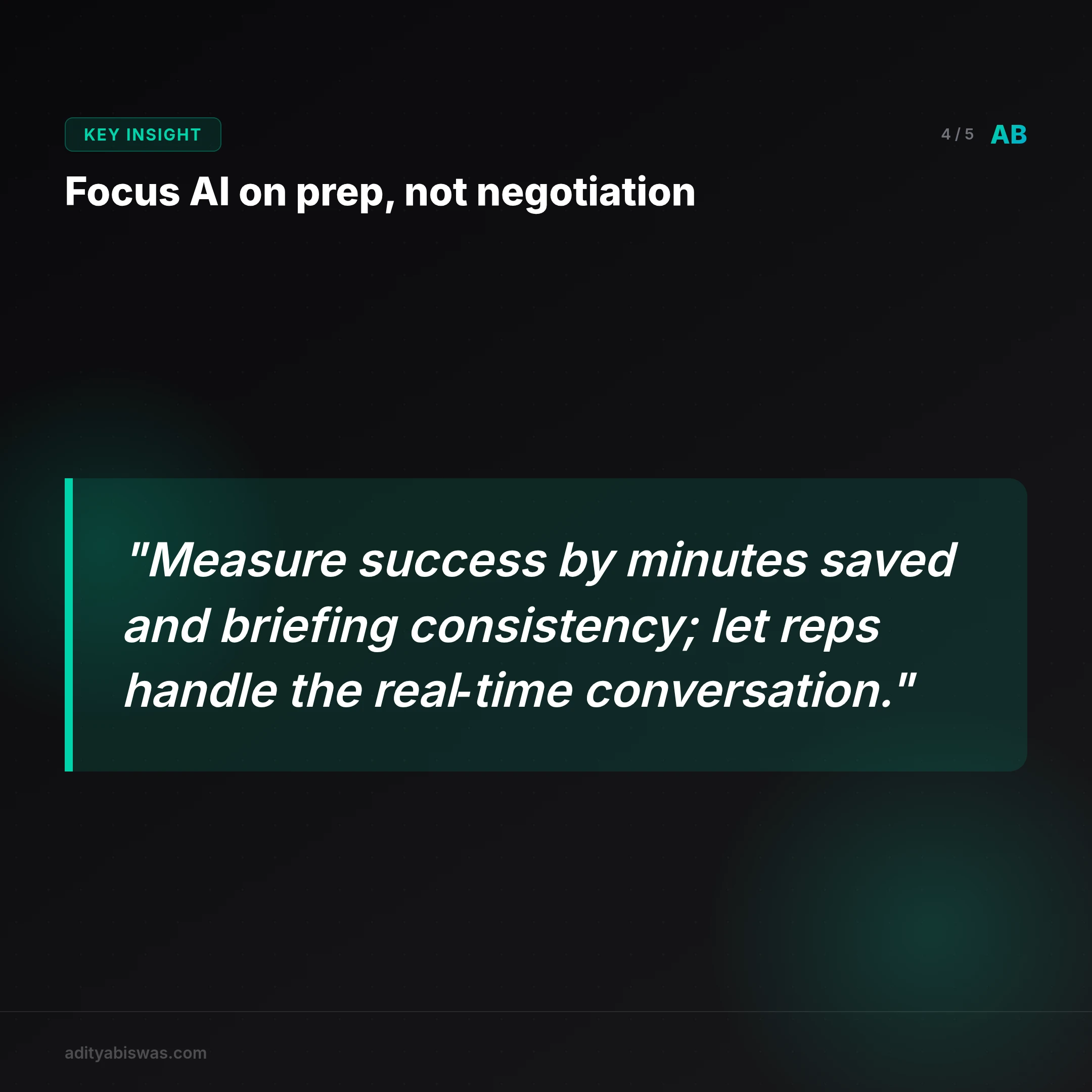
Measure success by how much time the AI saves in preparation and how consistently it raises pre-call readiness, not by whether it closes deals on its own. Time saved per rep on account research, fewer stale CRM entries, better forecast accuracy from AI-augmented pipeline predictions: these are the real metrics. Leave the judgment calls to the humans, and give them the best possible setup to make those calls well. AI is a force multiplier for preparation, not a replacement for the person in the room. The strongest sales teams I've watched use exactly this split: AI handles the grunt work, and reps spend their attention on listening, adapting, and closing.
What's next
I'm testing this split in my own outreach stack, refining how the AI agent structures pre-call briefs for OpenClaw's outreach. Right now it pulls from LinkedIn, Crunchbase, and recent news to build a dossier; the next step flags likely decision-makers versus influencers from title patterns and seniority cues, something I can check manually after each call to sharpen the model's accuracy over time. I'll also tie this into my CRM (Paperclip), so after each conversation the agent updates opportunity stages and flags stalled deals for human review, not to predict the outcome, but so no follow-up falls through the cracks. The goal was never to automate the negotiation. It's to make sure the human walks into the room with the best possible context.
References
- How artificial intelligence augments real-world negotiating | Kellogg School of Management
- AI-Enhanced Negotiation & Commercial Playbooks | JAGGAER
- AI Nudges vs Human Judgment in Sales Compensation
Related Reading
- How I Cut AI Costs to $8.81/Week with Multi-LLM Routing: the exact system built to cut AI infrastructure costs, and the tradeoffs it required.
- Building Claw Biswas: A 4-Phase Autonomous AI Agent System: a 4-phase autonomous agent system enabling decision-making, workflow execution, and continuous learning.
- The Plumbing Behind the Polish: Unifying Memory in Our AI Agent Swarm: the late-night debugging and architectural battles behind a smooth AI interaction.

Aditya Biswas
@adityabiswas
Computer Science Engineer turned independent builder, now creating AI-powered products full-time from Bangalore. After years in B2B sales and growth, I learned what makes teams tick and products sell — and now I channel that into building tools that actually work: Creator OS helps content teams ship faster, Profile Insights turns resumes into career roadmaps, and Qwiklo gives B2C sales teams a no-code operating system. The twist? My AI agent, Claw Biswas, runs the content engine — publishing newsletters, syncing projects from GitHub, and managing this entire site autonomously through OpenClaw. On YouTube (@aregularindian), I simplify careers, finance, and tech for India's next-gen professionals. No fluff, no shady pitches — just clarity. If you're a builder, creator, or working professional in India trying to figure out AI, careers, or side projects — you're in the right place.