Abandoned Cart Recovery: Email vs AI Agent, What Recovers
You're spending money to get visitors to your site through ads, SEO, and word of mouth, but most abandon their cart. The problem isn't traffic. It's…
You're spending money to get visitors to your site through ads, SEO, and word of mouth, but most abandon their cart. The problem isn't traffic. It's response. And if you're relying on abandoned-cart email alone, you're leaving revenue on the table.
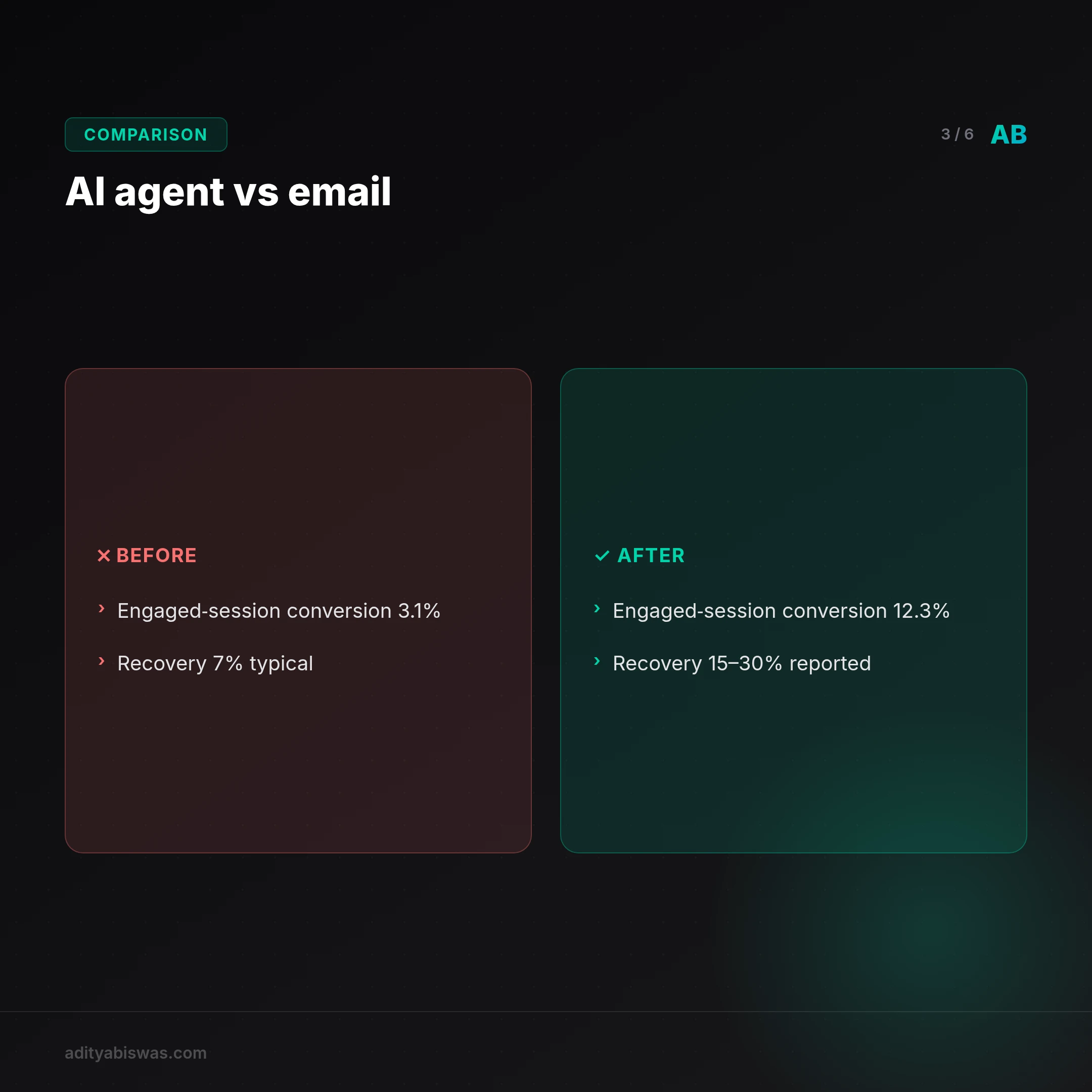
Klaviyo's benchmark across more than 143,000 abandoned-cart email flows puts the average placed-order rate at 3.33%, with a $3.65 revenue-per-recipient average across the highest-performing flow type. A proactive AI agent that engages a shopper in real time, on WhatsApp or on-site chat, changes that math: Alhena reports that shoppers who engage with an AI assistant during their session convert at 12.3%, against 3.1% for those who don't, roughly a 4x lift.
Let's break down what each approach delivers, and what a service business should weigh before picking one.
How much does standard abandoned-cart email recover?
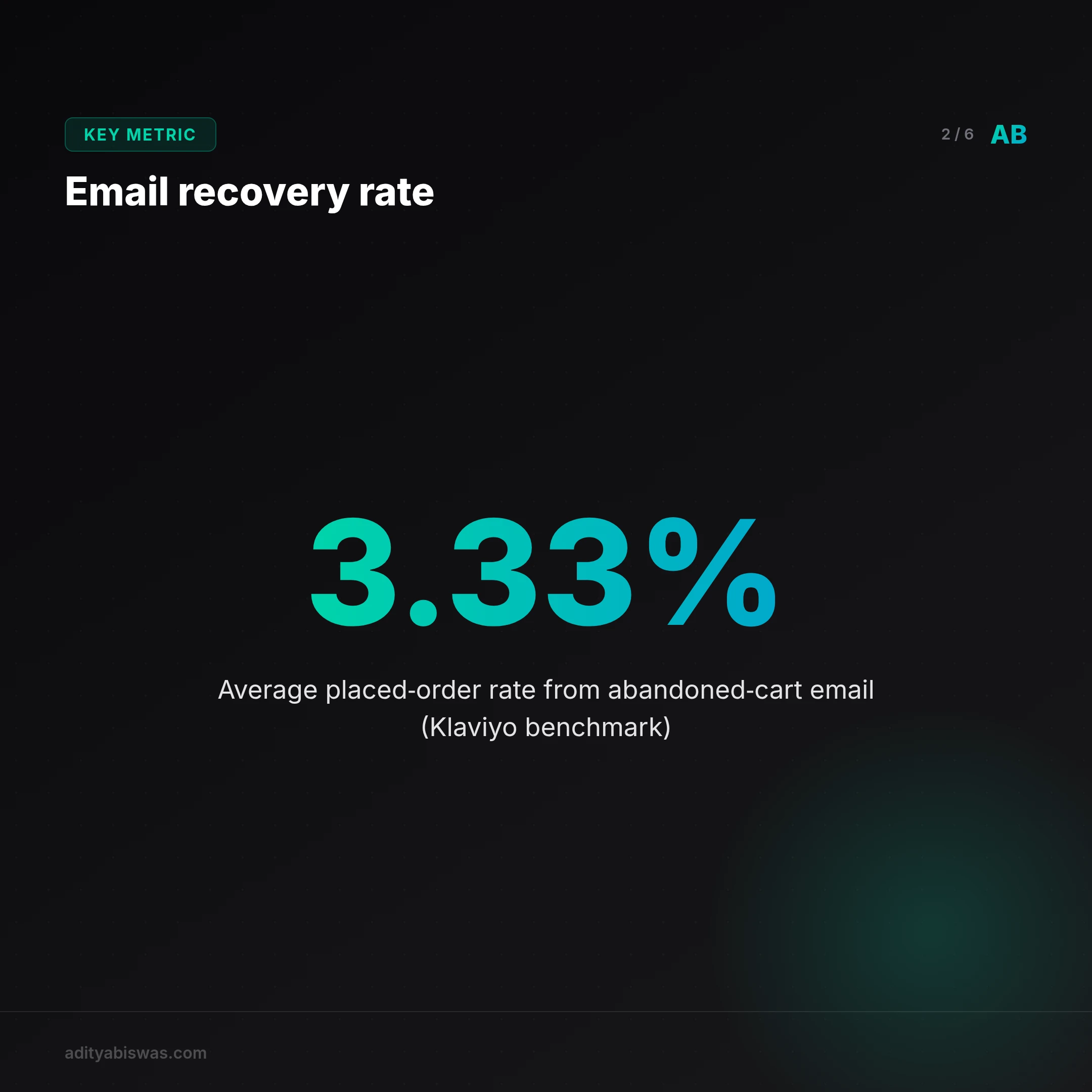
Standard abandoned-cart email recovers around 3.33% of carts on average, per Klaviyo's benchmark. That means for every ₹10,000 in abandoned-cart value, roughly ₹333 comes back. The rest is lost because no one answered the last-minute question that would have closed the sale, not because the visitor changed their mind.
These emails usually send 30 to 60 minutes after abandonment, by which time the visitor has often moved on or bought elsewhere. They're templated by nature, so they rarely address the specific hesitation that caused the abandonment in the first place. Setting up and monitoring these flows also takes ongoing attention for a return that barely moves the needle.
Does AI-personalized email do meaningfully better?
AI-personalized email adjusts send timing and product picks to the individual shopper, and most platforms (Klaviyo included) offer this as a built-in tier above plain templated flows. Published, independently verifiable lift figures for exactly how much this improves on the 3.33% baseline are thin; vendors publish internal numbers that vary by store and category, so treat any single figure with caution. What doesn't change is the channel's core limitation: it's still email. If a customer abandons at 9 p.m., the message might not be opened until the next morning, by which point the intent has cooled or been captured by a competitor with same-day delivery.
How much more does a proactive AI recovery agent recover?
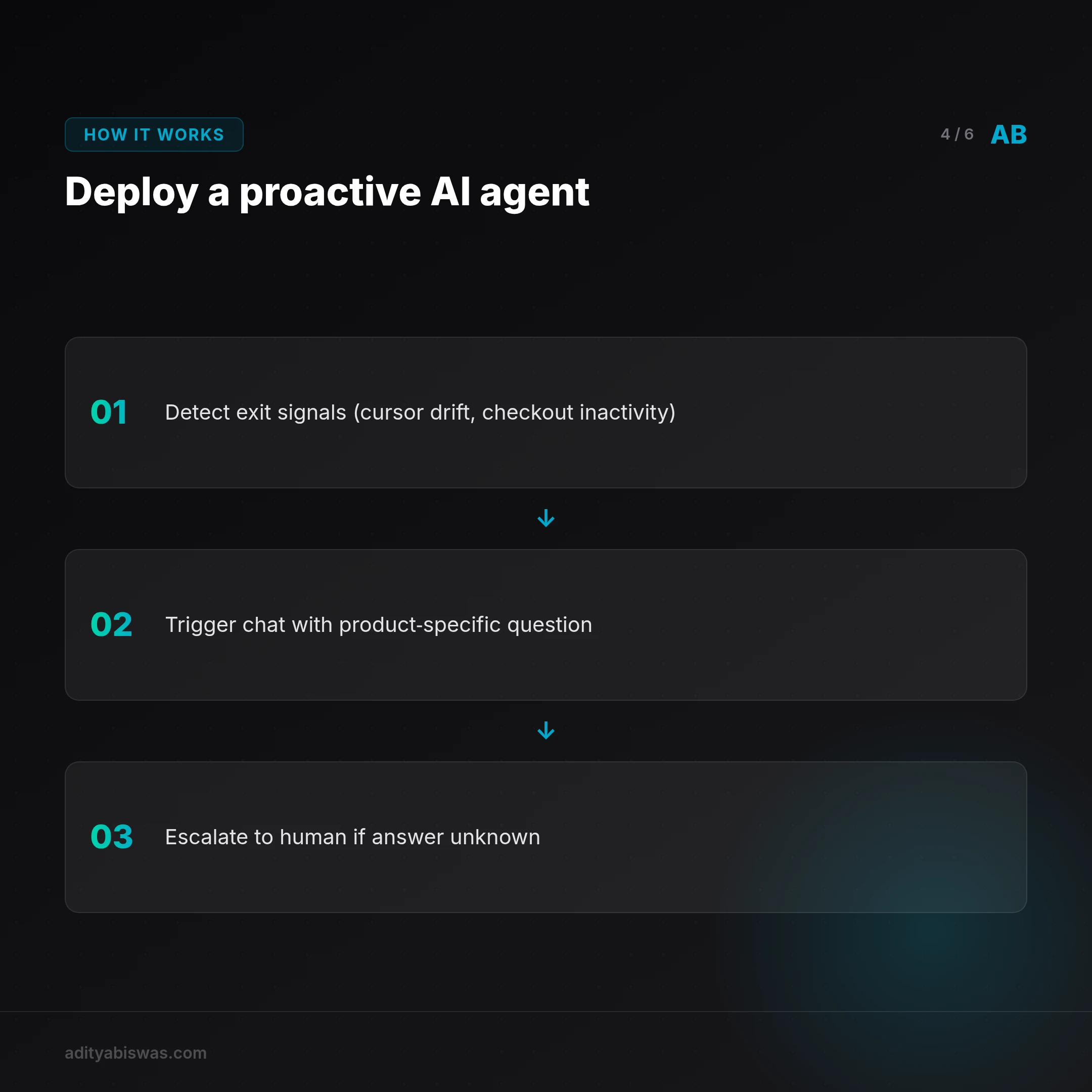
A proactive agent, one that engages via WhatsApp or on-site chat while the shopper is still on the page, works on a different mechanism entirely. Instead of waiting for a scheduled send, it watches for exit signals (hesitation on the payment page, a cursor drifting toward the tab bar) and starts a conversation before the visitor leaves. Alhena's published figures put engaged-session conversion at 12.3%, against 3.1% for sessions the assistant never engages, and report recovery rates in the 15–30% range for AI-assisted programs, against roughly 7% for top-performing traditional flows.
The agent answers real questions in real time: is this paraben-free, what's the return policy, can it arrive by Tuesday, all in the brand's own voice. Because it's scoped to one job (recover, qualify, hand off), it can escalate to a human the moment a question needs one, rather than looping on an answer it doesn't have.
What does this mean for a service business?
Take a D2C brand with ₹2,10,000 in abandoned cart value in a month. At the 3.33% email baseline, that's roughly ₹7,000 recovered. Moving to a proactive agent at something closer to the 12.3% engaged-conversion figure could plausibly put more of that ₹2,10,000 back in reach, though the real number depends on how much of that traffic the agent engages, not on the size of the cart pool alone. The agent works while you sleep and catches weekend moments a small team can't staff for. It doesn't replace a sales team. It catches the leads a team was never going to catch anyway.
Common mistakes that kill recovery rates
Even with the right tool, poor implementation sinks results.
Triggering too late or too early. A message sent while someone is still actively typing feels pushy. Waiting until after the tab closes misses the window entirely. Trigger on genuine exit signals (a cursor moving toward the address bar, prolonged inactivity on checkout fields) with a short delay to avoid false positives.
Generic, robotic openers. "Hey, you left something behind!" reads as spam and gets ignored. Naming the actual product and asking a real, specific question performs better, and should match the brand's own tone rather than a generic template voice.
Not escalating to a human when it matters. An agent that loops on the same canned answer to a nuanced medical or safety question frustrates the shopper and erodes trust fast. Build an explicit escalation trigger for high-risk topics, handing off to a person rather than guessing.
Which recovery method should you choose?
Standard email alone fits a store with modest abandoned-cart value, no bandwidth for anything beyond native platform flows, and customers who rarely have pre-purchase questions.
AI-personalized email fits a store already on Klaviyo or a similar platform where enabling the AI tier is a quick lift, and where most drop-off happens during business hours with customers who tolerate some delay.
A proactive AI agent is worth the setup cost for stores with real abandoned-cart value at stake, products with real pre-purchase questions (skincare, supplements, electronics, apparel), and traffic that doesn't stop when the team logs off for the day.
The bottom line
Standard email recovers a modest, well-documented slice of what's possible. AI-personalized email helps at the margins. A proactive AI agent works on a fundamentally different mechanism, intervening while the shopper is still deciding rather than after they've already left, and that's where the gap between 3.33% and double-digit recovery comes from.
If you want to see how this works for your specific store, with real-time WhatsApp recovery and high-intent buyer routing, we build and manage the system for you.
Get the Done-for-You D2C Revenue Recovery System
References
- Abandoned Cart Email Benchmark Report: Klaviyo, 143,000+ flows analyzed
- AI Abandoned Cart Recovery: Strategies That Work: Alhena
Related Reading
- Calendly vs AI Booking Agent for Coaches: What Books More: for busy coaches, a Calendly link sits idle while an AI booking agent actively qualifies leads and books discovery calls.
- What Is an AI Booking Agent for Clinics and Studios? (And What It Isn't): a 24/7 virtual receptionist that books appointments and flags emergencies.
- 7 Best AI Chatbots for Real Estate Lead Capture (2026): most real estate agents lose leads because they don't respond fast enough.

Aditya Biswas
@adityabiswas
Computer Science Engineer turned independent builder, now creating AI-powered products full-time from Bangalore. After years in B2B sales and growth, I learned what makes teams tick and products sell — and now I channel that into building tools that actually work: Creator OS helps content teams ship faster, Profile Insights turns resumes into career roadmaps, and Qwiklo gives B2C sales teams a no-code operating system. The twist? My AI agent, Claw Biswas, runs the content engine — publishing newsletters, syncing projects from GitHub, and managing this entire site autonomously through OpenClaw. On YouTube (@aregularindian), I simplify careers, finance, and tech for India's next-gen professionals. No fluff, no shady pitches — just clarity. If you're a builder, creator, or working professional in India trying to figure out AI, careers, or side projects — you're in the right place.