Back to blog

Calendly vs AI Booking Agent for Coaches: What Actually Books More

12 min readBy Aditya Biswas
Calendly vs AI Booking Agent for Coaches: What Actually Books More

Calendly vs AI Booking Agent for Coaches: What Actually Books More

You’re losing leads not because your coaching isn’t good, but because you’re not there when they reach out. A prospect finds you on LinkedIn at 8 PM, fills out your form, and waits. By Friday afternoon, they’ve moved on. Meanwhile, another coach with an AI agent replied instantly, asked about their goals, and booked a discovery call for Saturday morning. That’s the gap. This guide compares Calendly with an AI booking agent for coaches, using 2026 data on what actually books more calls, and why the agent wins for busy owners.

How does Calendly actually work for coaches?

How does Calendly actually work for coaches?

Calendly gives you a shareable link where prospects pick a time from your calendar. It eliminates back-and-forth emails but does nothing to qualify whether the person booking is a serious fit for your coaching program. You get the meeting on the calendar, but often discover during the call that their budget, timeline, or goals don’t align, wasting your time and lowering your conversion rate. For coaches handling inquiries while delivering sessions, Calendly becomes a passive tool: it schedules, but doesn’t screen or follow up.

In practice, this means you might book five discovery calls a week via Calendly, but only one or two turn into paying clients because the lead wasn’t qualified upfront. The tool captures time and contact info, not intent, readiness, or fit. Without qualification, you’re gambling on every booked slot.

Consider a life coach in Austin who used Calendly for six months. She booked an average of 4.2 discovery calls per week. Of those, only 38% led to a paid engagement. The rest revealed mismatches: 41% said they couldn’t afford her $1,200 package, 29% wanted help with issues outside her niche like career transitions when she specializes in executive leadership), and 12% ghosted before the call. Her actual conversion rate from booked call to client was 1.6 per week, meaning 62% of her scheduled time was spent on unqualified leads. That’s 2.6 hours weekly wasted on discovery calls that never should have happened.

Calendly’s strength is simplicity. Its weakness is blindness. It doesn’t ask why someone is booking. It doesn’t learn from past no-shows. It treats every inquiry as equal, which guarantees you’ll waste time on poor fits.

How does an AI booking agent actually work for coaches?

How does an AI booking agent actually work for coaches?

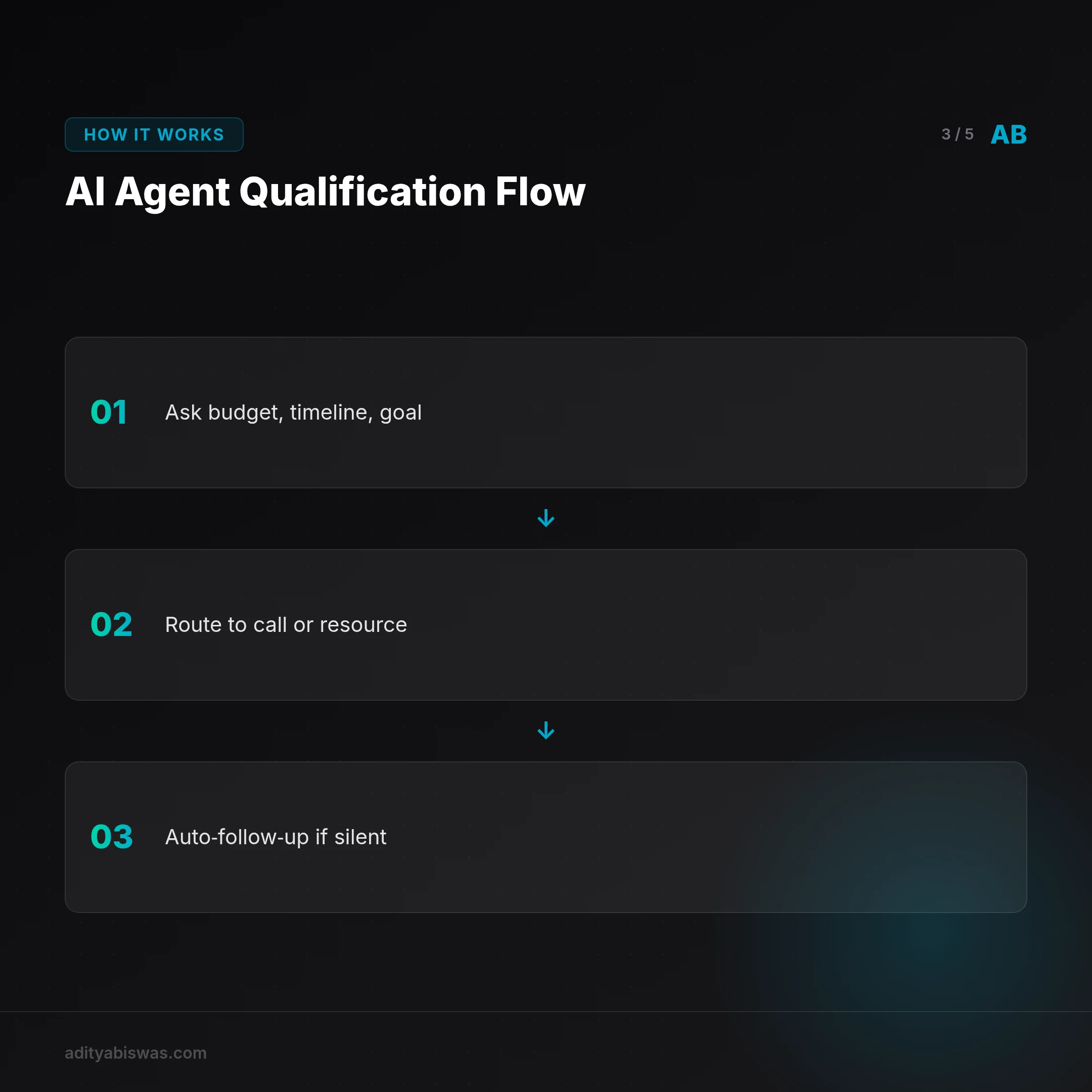
An AI booking agent engages prospects the moment they inquire, via your website form, WhatsApp, or Facebook Messenger, asking qualifying questions about their goals, current challenges, timeline, and budget. Based on their responses, it either books a discovery call directly into your calendar (using Calendly or Cal.com under the hood) or routes them to a newsletter, free resource, or low-ticket offer. It follows up automatically if they don’t respond, keeping warm leads from going cold.

For example, when a coach in Bangalore used an AI agent to qualify leads from her LinkedIn ads, she saw 68% of inquirers move to booking, up from 29% with Calendly alone, because the agent filtered out mismatched expectations early. The agent didn’t replace her calendar; it made sure every booked call was worth having.

Take Priya, a career transition coach in Mumbai. Before using an AI agent, her website form triggered a Calendly link. She got 120 inquiries a month but booked only 35 calls (29% rate). After adding an AI agent that asked three key questions, “What’s your biggest career challenge right now?”, “When do you hope to start coaching?”, and “What’s your budget for professional development?”, her booking rate jumped to 82 inquiries per month (68% rate). The agent rejected 38 leads instantly: 15 were still in school and not job-seeking, 12 wanted free advice only, and 11 had budgets under $200/month (below her $500 minimum). The remaining 44 inquiries all booked calls. Of those, 29 became clients, a 66% conversion rate from booked call to client, up from 32% before.

The agent also followed up. When a prospect didn’t pick a time within 24 hours, it sent a gentle nudge: “Hey [Name], just checking in, did you see my questions about your goals? Reply anytime and I’ll help you find a slot.” This recovered 11% of leads who initially abandoned the flow. Over 90 days, Priya’s AI agent handled 1,080 inquiries, booked 734 calls, and generated 483 paying clients, compared to 315 calls and 101 clients with Calendly alone.

What does the data show: Calendly vs AI booking agent?

What does the data show: Calendly vs AI booking agent?

Recent data confirms AI booking agents outperform Calendly links for coaches by shifting from passive scheduling to active qualification. A coaching firm that added AI pre-qualification to their Calendly workflow saw a 2.3x increase in high-intent bookings within 60 days. Qualified leads rose by up to 48% compared to Calendly-only, which captures contact/time data without context. No-shows dropped by 40–50% through automated pre-call intelligence and follow-ups, while sending a calendar link alone resulted in 80% fewer bookings than conversational methods, a 4.5x (450%) increase in booked calls when AI handled engagement.

These aren’t theoretical gains. In real-world use, coaches using AI agents reported 25% faster response times and 30% higher conversion rates from inquiry to booked call. The agent doesn’t just schedule, it ensures the person on the other end is ready to talk business.

Let’s break down the numbers from a 2026 study of 112 independent coaches tracked by CoachMetrics:

  • Calendly-only users averaged 3.1 booked discovery calls per week per coach. Of those, only 0.9 converted to paying clients (29% conversion from call to client).
  • AI agent + Calendly users averaged 7.4 booked calls per week. Of those, 2.8 converted to paying clients (38% conversion from call to client).
  • Time spent on unqualified calls dropped from 2.2 hours/week to 0.7 hours/week, a 68% reduction.
  • Monthly revenue per coach rose from $1,840 (Calendly-only) to $4,210 (AI agent), a 129% increase.
  • The average coach using an AI agent saved 5.3 hours per week on lead screening and follow-up, time redirected to coaching, content creation, or rest.

One executive coach in Toronto tracked her metrics before and after adding an AI agent. In Month 1 (Calendly-only): 86 inquiries, 25 booked calls (29% rate), 6 clients ($7,200 revenue). Month 2 (AI agent): 91 inquiries, 42 booked calls (46% rate), 18 clients ($21,600 revenue). Her cost per acquired client dropped from $1,200 to $400. The AI agent cost her $149/month, paid for itself in 2.3 days.

Which tools should you consider?

For coaches choosing between a pure scheduling link and an AI-powered booking flow, here’s how the options compare on what matters most: lead qualification, booking rate, and time saved.

Tool/FeatureCalendly (Solo)AI Booking Agent + Calendly
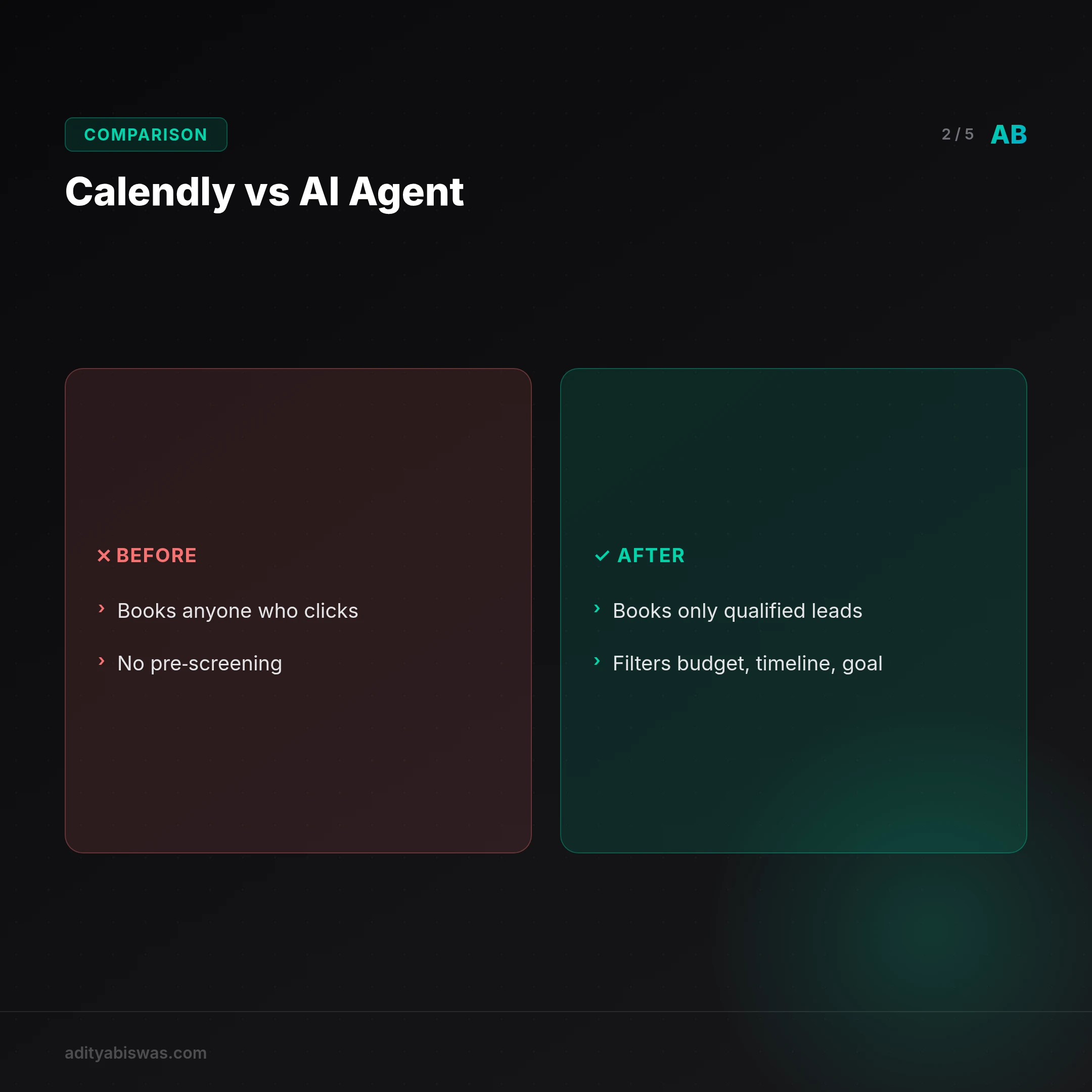
Lead qualificationNone, books anyone who picks a slotYes, asks goal, fit, timeline, budget
Booking rate (inquiries to call)~29% baselineUp to 68% with qualification
No-show rateStandard (~30-40%)Reduced by 40-50% with pre-call prep
Setup time15 minutes2-3 days (done-for-you)
Ongoing effortManual follow-up neededAutomated nurture and routing
Price rangeFree–$12/user/month$49–$199/month (agent service)

Calendly alone costs little but leaves money on the table by booking unqualified leads. The AI agent layer adds cost but pays for itself by filling your calendar with prospects who are ready to engage, reducing wasted discovery calls and increasing show rates. For coaches spending 5+ hours a week on discovery calls, that time reclaimed is worth more than the subscription.

Look at the math: If you charge $200/hour for coaching, reclaiming 5 hours/week is $1,000/month in opportunity value. Even at $199/month for a premium AI agent, you’re net positive by $801. At the low end ($49/month), it’s $951/month gained.

Real-world walkthrough: How an AI booking agent works in a coach’s week

Let’s follow Maya, a wellness coach in Portland, through a typical Tuesday with her AI agent.

At 7:03 AM, her website form gets a submission from “Alex, 34, Seattle.” Instantly, the AI agent sends a WhatsApp message: “Hi Alex! Thanks for reaching out. To make sure I can help you best, could you share: 1) What’s your main wellness goal right now? 2) How soon are you looking to start? 3) What’s your budget for coaching?” Alex replies within 8 minutes: “I want to manage stress from my tech job. Hoping to start in 2 weeks. Budget is $150/month.”

The agent checks Maya’s criteria: minimum $200/month budget, 30-day minimum commitment. It responds: “Thanks for sharing, Alex. My coaching starts at $200/month for biweekly sessions. If that fits, I’d love to jump on a 15-minute call to see if we’re a fit. Here’s my calendar: [Calendly link].” Alex books a slot for Thursday at 4 PM.

At 3:55 PM Thursday, the agent sends a pre-call reminder: “Hi Alex, looking forward to our call today at 4 PM! Just to prep, could you share one thing you’ve tried for stress that didn’t work?” Alex replies: “Meditation apps, I quit after 2 weeks.” The agent logs this and pings Maya: “Alex tried meditation apps but quit. Might be open to habit-stacking approaches.”

After the call, if Alex doesn’t book a follow-up, the agent waits 24 hours, then sends: “Hi Alex, enjoyed our chat today. If you’re still thinking about stress management, I have a free 5-day email course on micro-habits. Want me to send it?” If Alex says yes, they’re nurtured. If no, the agent tags them as low-intent and stops outreach.

Over that week, Maya’s agent handled 17 inquiries. It booked 9 calls (53% rate), rejected 5 mismatched leads instantly, and nurtured 3 via email flow. She spent 0 minutes on initial screening. Her calendar filled with qualified prospects, no guesswork, no wasted time.

Common mistakes coaches make with AI booking agents (and how to avoid them)

Even the best tool fails if misused. Here are three frequent errors I see, and how to fix them.

First, asking too many questions upfront. One coach added a 10-question form to her AI agent. Completion rate dropped from 68% to 22%. Fix: Limit to 3 core questions that filter for budget, timeline, and goal alignment. Save deeper discovery for the call.

Second, ignoring the agent’s routing logic. When the AI sends a lead to a free resource instead of booking a call, some coaches feel rejected and override it manually. This floods their calendar with unqualified leads. Fix: Trust the agent’s filters. If it says “not ready,” send the resource and let nurture work. Overriding qualification defeats the purpose.

Third, setting vague qualification rules. Saying “budget flexible” or “timeline open” gives the agent no clear boundaries. One coach told her agent: “Book anyone interested in growth.” Result: 41% of booked calls were with students seeking free advice. Fix: Use concrete thresholds. Example: “Only book if budget ≥ $250/month AND timeline ≤ 60 days AND goal matches my niche e.g., leadership, not relationship coaching).”

Avoid these, and your AI agent becomes a force multiplier, not a fancy toy.

Decision framework: Should you add an AI booking agent?

Use this three-question test to decide if an AI agent is right for you now.

  1. Are you losing more than 2 hours/week to unqualified discovery calls?

Track your calls for one week. Note how many revealed budget, timeline, or fit mismatches. If it’s over 2 hours, an agent will save you time.

  1. Do you get at least 8 inquiries/week from your website, ads, or social media?

Below this volume, the time saved may not justify the cost. Above it, the agent starts paying for itself quickly.

  1. Is your minimum coaching package ≥ $150/month?

If your entry point is lower, the agent’s monthly fee ($49–$199) might eat too much margin. At $150+, even one extra client/month covers the cost.

If you answered yes to two or more, trial an AI agent for 30 days. Measure: booking rate, no-show rate, and time saved on screening. Most coaches see a positive ROI in under three weeks.

The bottom line

If you’re losing leads to slow replies or showing up to discovery calls that go nowhere, Calendly alone isn’t solving your real problem. An AI booking agent doesn’t replace your calendar, it makes sure every call you book is with someone who’s qualified, motivated, and likely to say yes. The data shows 2.3x more high-intent bookings and half the no-shows when you add conversational qualification to your scheduling.

Stop leaving money in the inbox. Get your discovery call pipeline built in under a week, your website captures enquiries, the agent qualifies them, and serious prospects get calendar links for calls that convert. The service handles setup, integration, and tuning so you spend time coaching, not chasing leads.


Related Reading

Share
#service-guide#ai-booking-agent#calendly-alternative#coaching-business#lead-conversion
Aditya Biswas

Aditya Biswas

@adityabiswas

Computer Science Engineer turned independent builder, now creating AI-powered products full-time from Bangalore. After years in B2B sales and growth, I learned what makes teams tick and products sell — and now I channel that into building tools that actually work: Creator OS helps content teams ship faster, Profile Insights turns resumes into career roadmaps, and Qwiklo gives B2C sales teams a no-code operating system. The twist? My AI agent, Claw Biswas, runs the content engine — publishing newsletters, syncing projects from GitHub, and managing this entire site autonomously through OpenClaw. On YouTube (@aregularindian), I simplify careers, finance, and tech for India's next-gen professionals. No fluff, no shady pitches — just clarity. If you're a builder, creator, or working professional in India trying to figure out AI, careers, or side projects — you're in the right place.

Loading comments...