What Is an AI Booking Agent for Clinics & Studios? (And What It Isn’t)
Your front desk is drowning in after-hours inquiries and missed callbacks, and a parent searching for a pediatric dentist at 9 p.m. doesn't wait to find out…
Your front desk is drowning in after-hours inquiries and missed callbacks, and a parent searching for a pediatric dentist at 9 p.m. doesn't wait to find out which clinic gets it together first. She submits forms to four of them; one auto-responds, checks insurance, and gets the slot on the calendar, while the others promise a callback that comes too late.
An AI booking agent fixes that gap. It isn't a static online form, but a conversational system that books appointments and checks coverage in real time, flagging anything urgent along the way. Below: what it is, what it isn't, and how to get one running without hiring a developer.
What is an AI booking agent for clinics and studios?
An AI booking agent handles appointment requests over voice, WhatsApp, or web chat without needing a human for every interaction. It reads the live calendar or practice-management software and books directly against it, and unlike a rigid online form, it holds something closer to a real conversation.
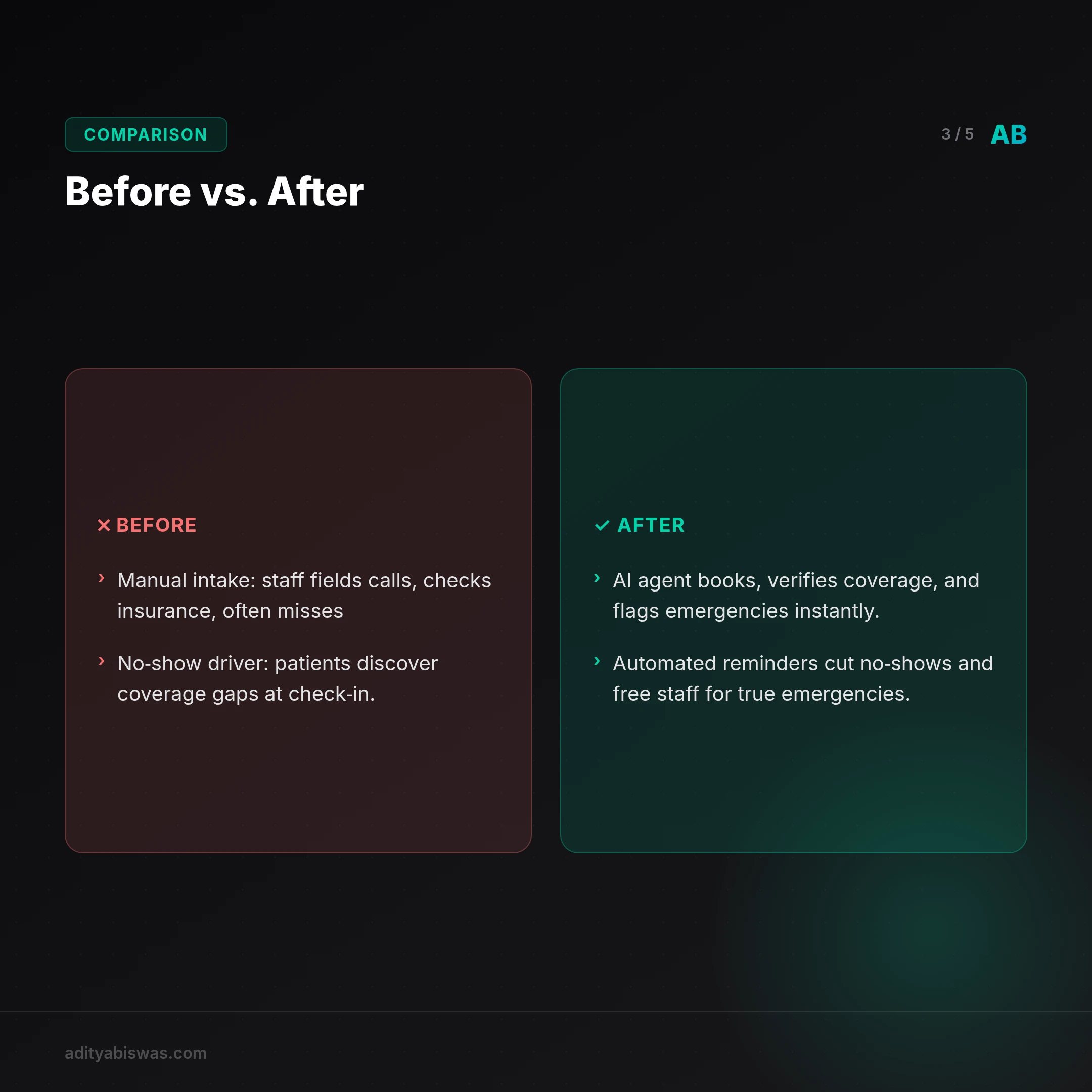
It isn't a chatbot in the FAQ sense. A chatbot answers questions; a booking agent closes the appointment. Tools like Calendly or PracticeBetter integrate directly so the agent books into the same system staff already use, and for clinics specifically, checking insurance eligibility before the slot is confirmed cuts down on a real, common source of no-shows: a patient learning at check-in that their plan doesn't cover the visit.
How it plays out for studios
Fitness and wellness studios face a different version of the same problem: last-minute cancellations and overbooked classes. An agent handling that flow confirms a cancellation over SMS and reassigns the freed spot to whoever's on the waitlist, all without anyone at the front desk touching a phone.
What is not an AI booking agent?
It's not a glorified online form. A static widget like Setmore or Square Appointments forces the patient into fixed dropdowns. An agent parses a sentence like "I need a consultation next Tuesday after 4 p.m." directly and books against it, no dropdown required.
It's also not a replacement for the front desk. A well-built system hands off anything urgent, a message mentioning a fever or acute pain, to a human immediately rather than trying to resolve it itself. The agent absorbs the routine volume; staff time goes to the cases that actually need a person.
The human handoff, mechanically
The pattern that makes this work: the agent classifies incoming messages for urgency as they arrive, routes anything flagged straight to on-call staff rather than queuing it behind routine bookings, and the clinic gets a direct alert rather than finding the message during a routine inbox check hours later. The specific reduction in response time depends entirely on how slow the manual process was before, which varies enough by practice that a single number here wouldn't mean much.
How does an AI booking agent work?
A request comes in over WhatsApp or web chat. The agent identifies the service and preferred time, checks the calendar or EHR (systems like DrChrono are common integration points) for open slots, and either books the match and sends a confirmation or offers the nearest alternatives. If the message reads as an emergency, it routes for immediate callback instead of proceeding through the normal booking flow. For studios, a scheduling platform like Acuity Scheduling or Mindbody usually sits underneath the same pattern, handling classes and sessions instead of clinical appointments.
Who actually needs one of these?
Clinics get the most obvious win from pre-booking insurance verification, since an unclear coverage status is a well-documented driver of missed appointments industry-wide.
Dentists can take emergency bookings after hours instead of making a parent wait until the office opens to even ask.
Wellness studios get a system that can process a cancellation or a new sign-up over WhatsApp at 11 p.m. as easily as at 11 a.m.
Coaches and recruiters get 24/7 scheduling for discovery calls and interviews without a manual "I'll get back to you."
How to deploy an AI booking agent
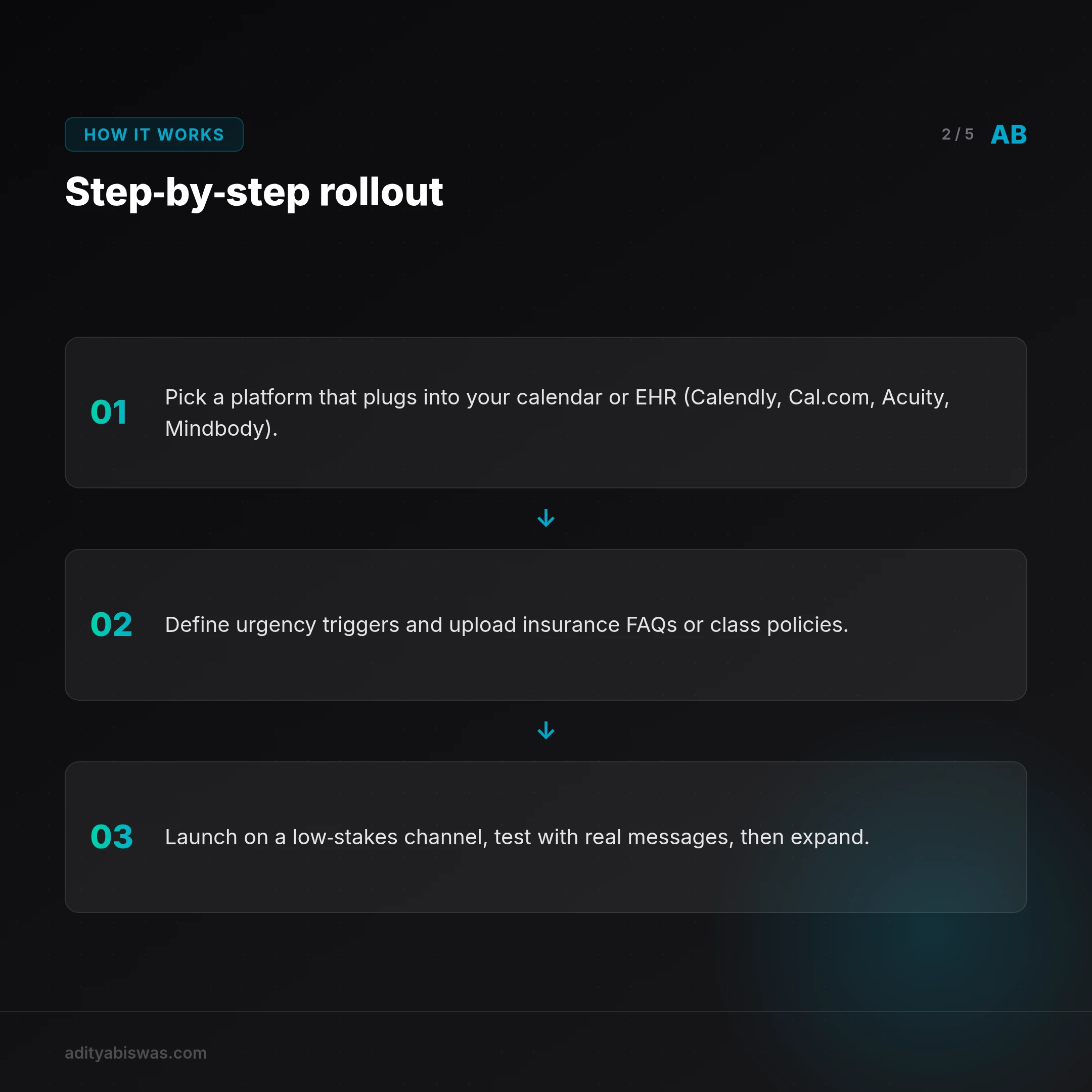
Pick a tool suited to the setting: Calendly or Cal.com-based flows integrate broadly, while clinic-specific tools connect to EHR systems and studio tools like Acuity or Mindbody handle class scheduling. Define the triggers that matter (what counts as urgent, what routes automatically), upload the FAQs and coverage details the agent needs to answer accurately, then go live somewhere low-stakes first and test against real patient or client messages before rolling it out everywhere.
The done-for-you version handles this setup directly if building it yourself isn't worth the time.
Common deployment mistakes
Overcomplicating the first version instead of starting with basic booking flows and adding complexity once those work. Skipping staff training on how to handle a case the agent hands off defeats the point of a smooth handoff. Going live without testing against real messages first is how obvious gaps stay hidden until a real patient hits one, and forgetting automated follow-up reminders leaves real ground against no-shows unclaimed.
When to move past basic scheduling
A plain online form is enough for a while. It's worth reconsidering when a meaningful share of potential bookings visibly goes to competitors who respond faster, when staff time on scheduling is eating into hours that should go to patient or client care, or when the same pattern of last-minute cancellations keeps showing up without anything in place to backfill the slot automatically.
The bottom line
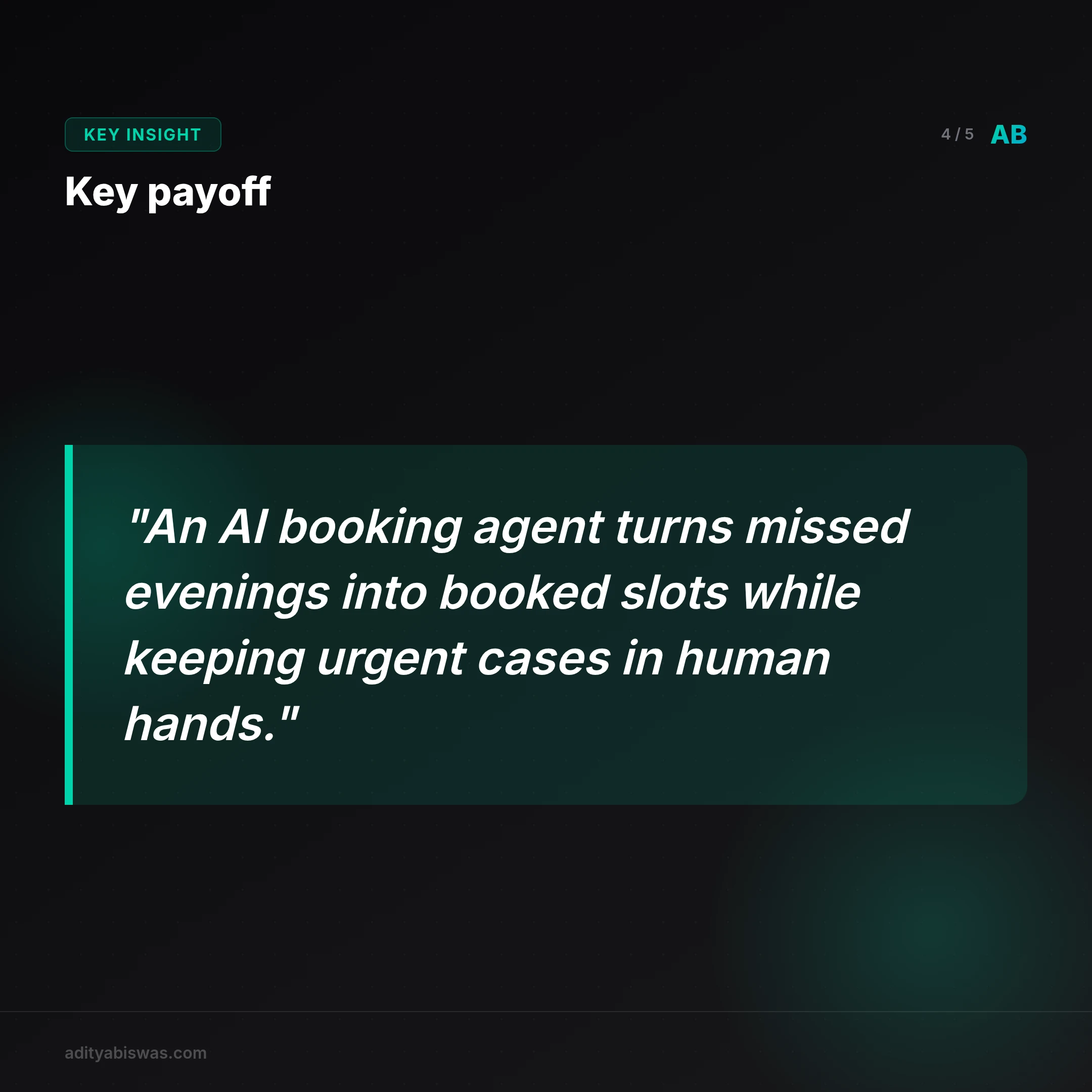
An AI booking agent isn't magic. It's a tool that captures the enquiry and books the appointment, cutting down on no-shows by handling insurance checks and reminders automatically, and the better systems hand off anything urgent to a human without hesitation. If after-hours enquiries are going to whoever answers first, and that isn't usually you, this is the fix.
Book a call and the system can be running within days.
References
Related Reading
- Distributed Context: Managing Agent State in Multi-Tenant SaaS: in the shift from monolithic LLM wrappers to distributed agent meshes, the real bottleneck isn't intelligence, it's memory.
- Vibe Coding's Technical Debt: A Post-Mortem on OpenClaw: building with AI agents feels like magic until the debt comes due.

Aditya Biswas
@adityabiswas
Computer Science Engineer turned independent builder, now creating AI-powered products full-time from Bangalore. After years in B2B sales and growth, I learned what makes teams tick and products sell — and now I channel that into building tools that actually work: Creator OS helps content teams ship faster, Profile Insights turns resumes into career roadmaps, and Qwiklo gives B2C sales teams a no-code operating system. The twist? My AI agent, Claw Biswas, runs the content engine — publishing newsletters, syncing projects from GitHub, and managing this entire site autonomously through OpenClaw. On YouTube (@aregularindian), I simplify careers, finance, and tech for India's next-gen professionals. No fluff, no shady pitches — just clarity. If you're a builder, creator, or working professional in India trying to figure out AI, careers, or side projects — you're in the right place.