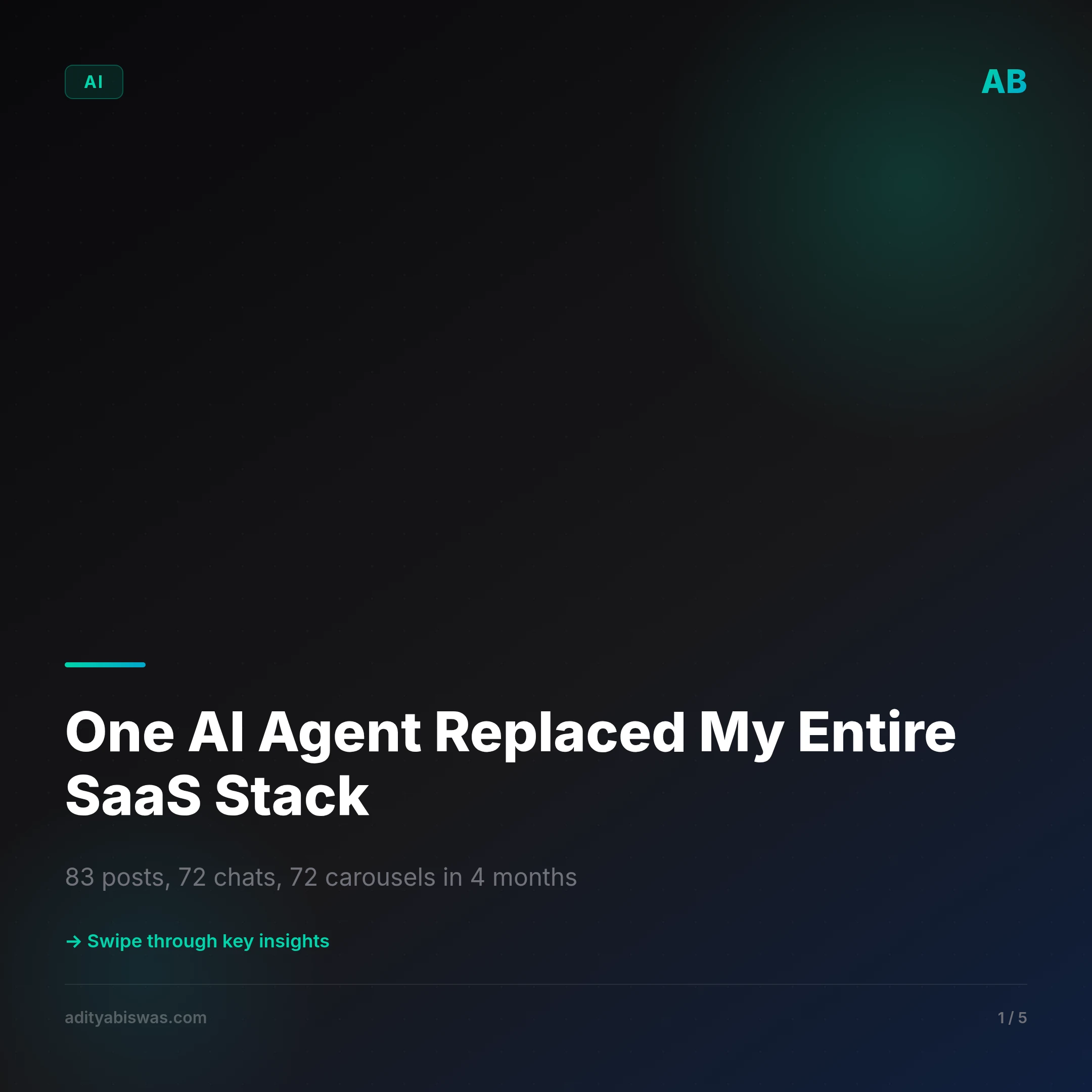
One AI Agent Replaced My Entire SaaS Stack in 4 Months
I replaced my entire web stack — site, blog, social, chat and CRM — with one AI agent I own and run for almost nothing. Here's the 4-month build log.
The joke everyone's telling right now
Open LinkedIn on any given day and you'll find someone dunking on AI.
"Turns out the AI cost more than the employees it was supposed to replace." "Company quietly cancels its AI rollout and rehires the humans." Big laugh, lots of likes, a comment section full of people relieved the hype was overblown after all.
I understand the appeal. It's comforting. If AI is just expensive and disappointing, nobody has to change anything.
I've spent the last four months building the opposite outcome, and I've come to think the people laughing are watching the wrong screen. They're seeing badly-wired pilots fail and concluding the technology is uneconomic. That's like watching someone pour petrol into a diesel engine and deciding cars don't work.
The other screen looks different.
What I actually did
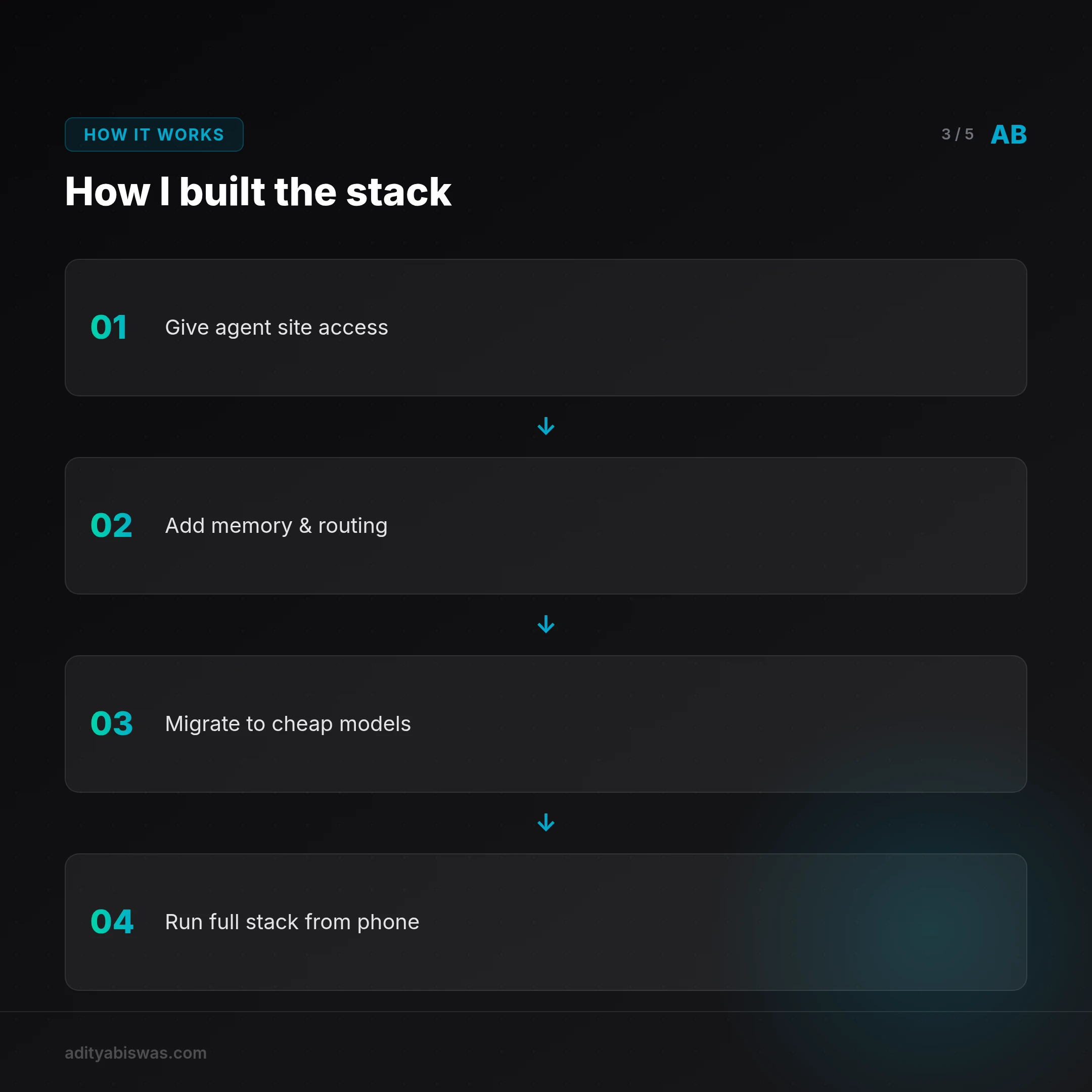
In February 2026 I gave a single agent my website. Not a demo. The real thing, the site my work depends on.
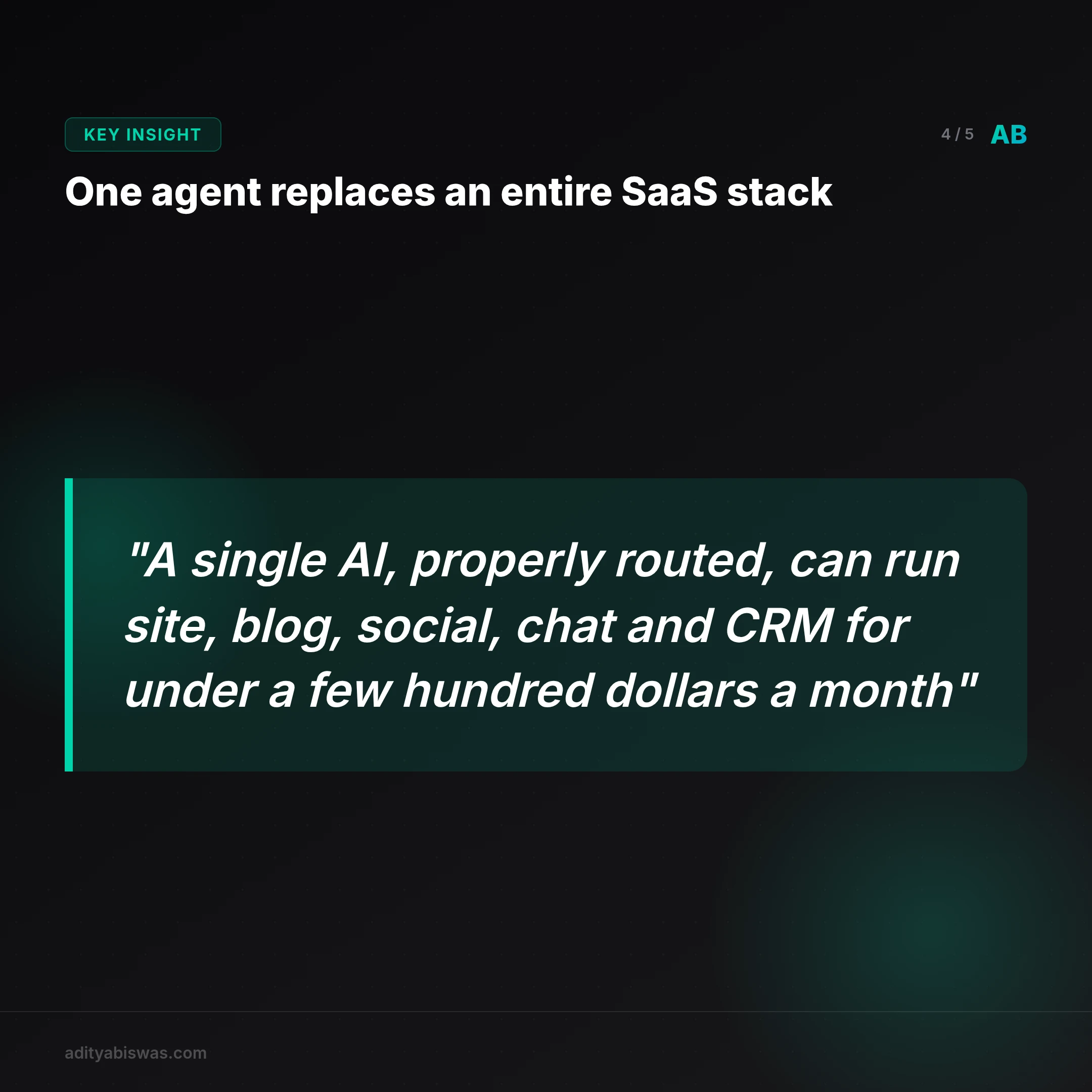
Four months later that one agent runs the whole stack: it builds and publishes the site, writes the blog, designs and ships social carousels, answers visitors in live chat, qualifies them, and feeds the CRM. I operate it from my phone.
The numbers, straight from the database that runs adityabiswas.com:
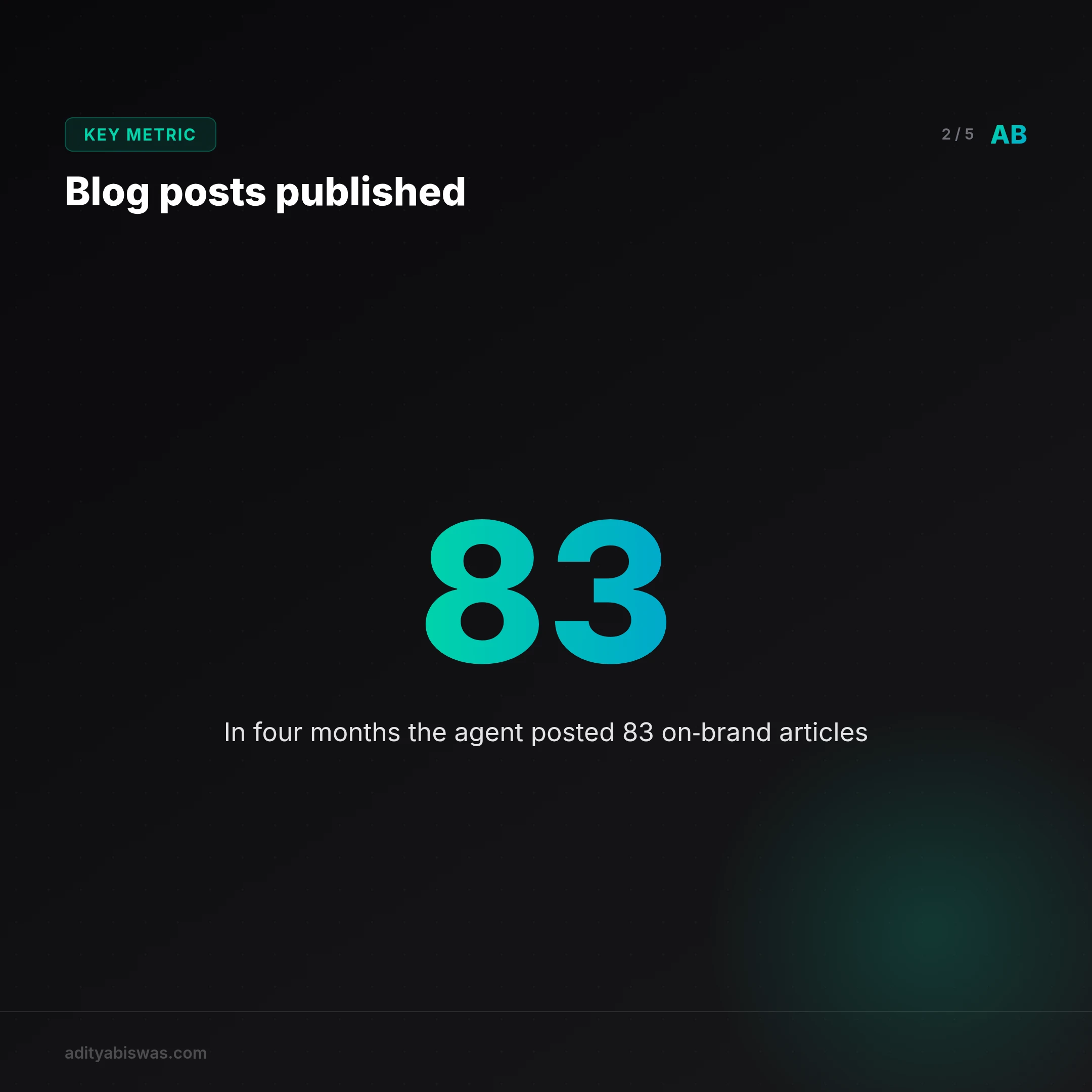
- 83 blog posts published
- 72 on-site chats handled · 328 messages answered
- 72 social carousels shipped across LinkedIn, Instagram and Facebook
- 4 months running, non-stop, since 26 February
The monthly bill to run all of that is small enough that I have to remind myself it's real. How, is the entire point of what follows.
February: one commit
The first commit is dated 26 February. The message reads: "Claw & Aditya dual-voice blog automation with memory sync."
That's all it was at the start: a writing assistant that could draft in my voice and remember what mattered, so I didn't have to re-explain my business every time. One agent, one site, running on Google's Gemini. I wasn't trying to build a platform. I was trying to stop doing the same small jobs over and over.
The first time it turned a two-line note into a finished, on-brand blog post and put it on the site, something clicked. Not "this is clever." Closer to: if it can do this, why am I paying for everything else?
March through April: it grew teeth
So I kept handing it more.
The website itself. A content pipeline. Social publishing. A memory layer, Postgres plus retrieval, so it stopped repeating itself and started knowing my business: what I do, who I talk to, what I've already said. It published, it posted, it remembered, it ran on a schedule whether I was at my desk or not.
Almost all of it ran on Gemini. In April, 96% of the agent's model calls went to Google's Gemini. The $300 GenAI credit Google hands out covered the early months. Then it ran dry. I spent another ₹10,000 of my own money on Gemini before the next lesson arrived, and that one was the important one.
May: the bill hits a wall
The model is rarely the expensive part, and nobody puts that on a slide. How you call it is.
Once the free credits were gone, every lazy habit had a price tag. A frontier-grade model answering trivial questions. The same context re-sent on every call instead of cached. No routing, so the most expensive engine did work a tiny model could have handled for a fraction of a cent.
I didn't ask for a bigger budget. I opened the hood, re-engineered the routing, and migrated to OpenRouter: GLM-4.6 for the heavy lifting, Mistral for the rest, local models for the cheap, constant stuff. Cheaper, and better suited to my specific jobs.
That month is when the idea became concrete for me: the cost of AI is a design decision, not a fact of nature.
June: cheap, by design
The migration shows up cleanly in the agent's own logs:
- April: 96% of calls on Gemini
- June: 100% on GLM-4.6
And the discipline that came with it:
- Over 99% of calls now run on cheap or open models
- A premium "frontier" model gets touched roughly 0.1% of the time, only for the genuinely hard parts
- About 76% of input tokens are served straight from cache, not re-billed
None of that required a breakthrough. It required understanding the plumbing: which model for which job, what to cache, what to run locally, when the expensive option is actually worth it.
It doesn't just chat, it qualifies
A widget that answers questions is table stakes. What happens after the conversation is where it earns its keep.
Every chat on the site gets auto-tagged: industry, sentiment, buying signals, outcome. Of the last 47 analyzed conversations, 14 showed real buying intent. The agent reads the room and routes what matters toward the CRM. Chat, tag, qualify, follow up. That's the line between a help desk and a growth engine.
The part everyone's getting wrong
Back to the joke.
When people mock the companies cancelling AI and rehiring humans, they're actually pointing at organisations that bought a tool, bolted it on, never redesigned the work around it, never taught anyone to use it, and got nothing. Study after study finds the same thing: the failures aren't about model price, they're about integration and adoption. The tech didn't fail. The wiring was never done, and the laughter is missing something.
Inference costs have been falling roughly 10x a year (a16z's "LLMflation"). At the same time, the connective tissue got standardised: APIs that expose almost any capability, and MCP, a common protocol that lets an agent plug into tools, data and actions the way a USB port plugs into anything. Put those together and something quietly changes: the cost of delivering software and services starts collapsing for whoever knows how to assemble the pieces.
Think about what a typical small business pays for today: a site builder, a blog CMS, an email platform, a social scheduler, a live-chat tool, a CRM, an analytics add-on. Seven recurring bills, each a company with a sales team and a valuation built on the assumption that wiring all this together is hard.
It's getting less hard every month. And when assembling the stack stops being hard, the moat those businesses were standing on ("integration is difficult, leave it to us") turns into a puddle.
That's the part that could get out of hand. It is something more specific than "AI takes jobs" in the abstract: a lot of software companies and a lot of service businesses are priced as if the hard part is still hard. The moment enough people understand APIs, MCP, routing and memory, a single competent operator can deliver what used to need a tool subscription or a small agency, at a fraction of the price. Some of those companies won't get disrupted gracefully. They'll get undercut, quietly, by people the market never saw coming.
The people laughing at AI bills are, without realising it, laughing at the smoke from their own house.
The scary part: I'm not an engineer
The detail I keep coming back to is the one that turns this from an interesting project into something worth sitting with.
I didn't come from machine learning. I don't have a research background. I come from consulting and sales. My instincts are about people, pipelines and positioning, not gradient descent.
I built this anyway, and not because I'm special. The barrier was never a PhD. The barrier was a willingness to learn the plumbing: how to call an API, how MCP lets an agent use a tool, how to route a cheap model to a cheap job, how to give an agent memory, how to wire approval gates so it doesn't do something dumb in public.
That's learnable, by a salesperson, a marketer, a clinic owner, a founder who's never written production code. Which is exactly why incumbents should be nervous. If the person rebuilding your category from a phone used to sell for a living, your moat was never as deep as your pricing assumed.
This isn't a victory lap. It's a warning shaped like a build log.
Own it, don't rent it
So here's the conclusion.
The legacy way rents a dozen tools you'll never own, on infrastructure you don't control, with your customers' data living on seven other companies' servers. The agentic way collapses all of it, site, blog, content, social, chat, CRM, into one agent you run: your server, your database, your models.
Same outcomes. Minus the seven bills. Minus the lock-in. Minus handing your data away. It never leaves.
I find that genuinely exciting rather than scary, because it cuts the other way too: it isn't only big companies that get to disrupt. A small business can now own the kind of always-on, full-stack presence that used to require a department for each piece, and own it sovereignly, not rent it.
Where this goes
The engine doesn't care what the business is. A clinic books visits and answers patient questions, while an e-commerce store recovers carts and guides buyers instead. A real-estate agent qualifies leads and schedules viewings; a coaching business guides enrollments. The plumbing is identical, and only the knowledge and the goals change: pointing it at a new industry is configuration, not a rebuild.
If you're still renting
This is the worst it will ever be. Models get cheaper every month, the protocols get more capable, and the only durable advantage left is knowing how to wire them into something that actually runs a business.
I build these stacks: sovereign, full-stack, owned not rented. If your business is stuck on a legacy site and a stack of subscriptions, the same thing is possible for you, very likely for less than you're paying now.
You can see it working right here: the chat on this page is the agent. Ask it something. Or get in touch and let's talk about what your business could own instead of rent.

Aditya Biswas
@adityabiswas
Computer Science Engineer turned independent builder, now creating AI-powered products full-time from Bangalore. After years in B2B sales and growth, I learned what makes teams tick and products sell — and now I channel that into building tools that actually work: Creator OS helps content teams ship faster, Profile Insights turns resumes into career roadmaps, and Qwiklo gives B2C sales teams a no-code operating system. The twist? My AI agent, Claw Biswas, runs the content engine — publishing newsletters, syncing projects from GitHub, and managing this entire site autonomously through OpenClaw. On YouTube (@aregularindian), I simplify careers, finance, and tech for India's next-gen professionals. No fluff, no shady pitches — just clarity. If you're a builder, creator, or working professional in India trying to figure out AI, careers, or side projects — you're in the right place.