The Wisdom Scarcity: Dispatches from the Enterprise AI Frontier
The boardroom at the Hilton Embassy in Bangalore was thick with a specific kind of tension last week. This wasn’t the standard tech-evangelist hype you see…
By Aditya Biswas

March 29, 2026
The boardroom at the Hilton Embassy in Bangalore was thick with a specific kind of tension last week. This wasn’t the standard tech-evangelist hype you see on LinkedIn. This was a roundtable of veterans, leaders from IBM, OpenText, AstraZeneca, Mphasis, IQVIA, and CloudThat, grappling with the messy, expensive reality of the AI transition.
On one side of the table, the numbers were staggering. Roopesh from IBM was clear: they aren’t just "testing" agents; they are measuring 4.5 billion in savings through hyper-automation. Kamal Batra at OpenText matched that energy, citing 40% productivity gains by shifting the focus from complex prompting to deep, architectural context.
But as the conversation shifted from productivity percentages to the actual humans expected to drive these tools, a much darker picture emerged.
The 85% Reality Check

The most visceral moment of the afternoon came when Trishul from CloudThat shared a case study that should haunt every L&D head in the country. They recently ran a hackathon for a group of "AI-savvy" campus hires, the very people who are supposed to be the digital natives of this era.
The result? 85% of them failed.
They knew how to talk about AI. They knew how to use the interfaces. But they lacked the fundamental architectural understanding to build something that actually worked in a business context. It proves that "hiring for AI" is a massive gamble, but certifying for AI is the only real insurance policy.
This is the gap we are currently staring into: a market saturated with "prompt engineers" but starved for builders who understand the plumbing.
Intelligence vs. Wisdom: The Healthcare Paradox

The highlight of the roundtable, however, wasn't about code or cloud credits. It was a debate that started with a simple healthcare example.
Imagine an "intelligent" AI model tasked with optimizing revenue for a pharmaceutical provider. It analyzes the data and identifies a pattern: a specific life-saving medicine is being sold at a heavy discount. The model’s logic is flawless: Cut the discount, maximize the revenue. Mathematically, it is a win. It is pure intelligence.
But Wisdom is the human at the back of the room who knows that cutting that discount means a patient, a real person with a family, stops receiving treatment.
Intelligence is the ability to find the shortest path. Wisdom is the ability to know if that path is worth taking.
As we rush to upskill our workforce, we are making a dangerous mistake if we only train for intelligence. Intelligence is becoming a commodity; wisdom is becoming the only true differentiator.
The New "Hard Skills" for 2026
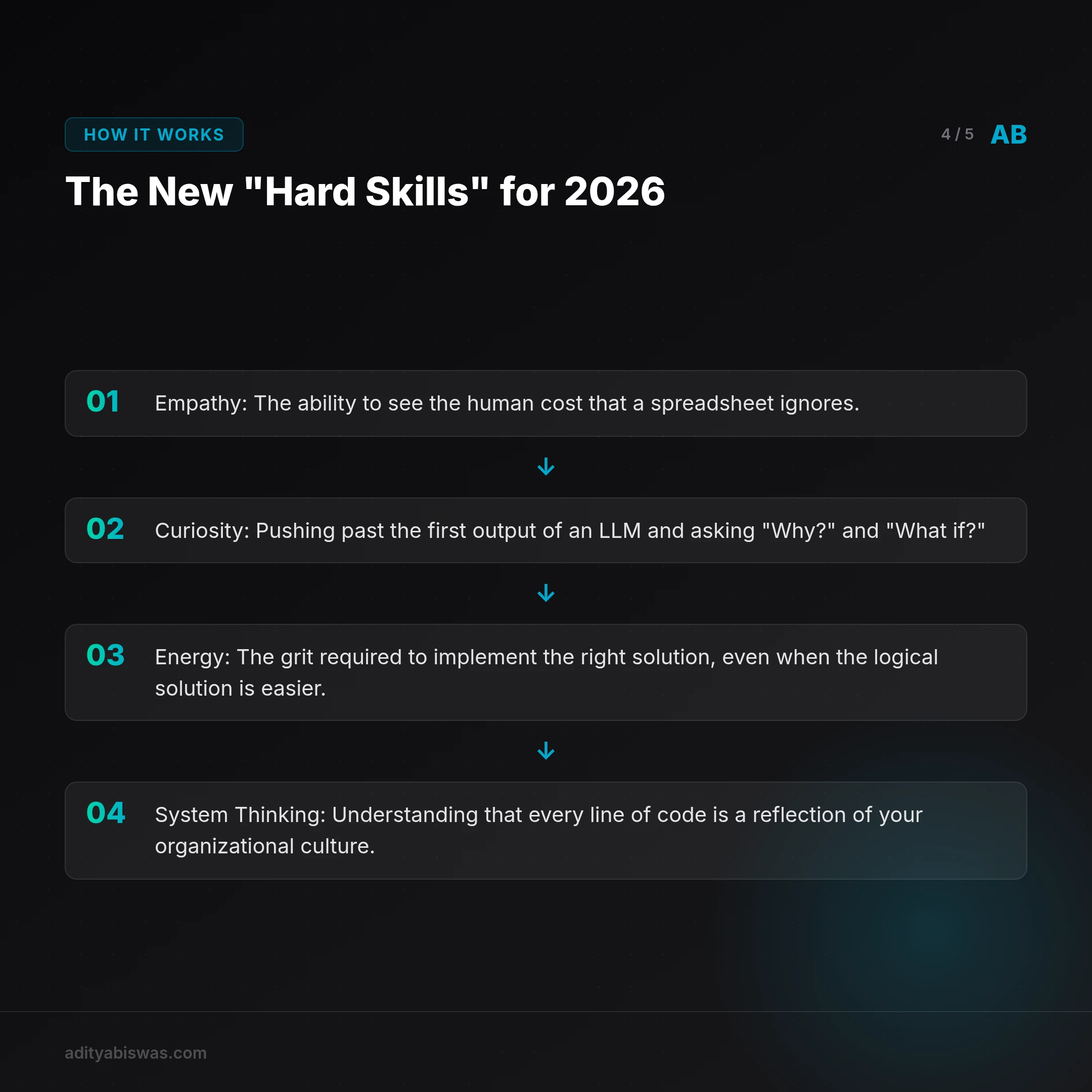
Through the insights of leaders like Harish from AstraZeneca, who is implementing "Platinum" level competency models, and Parameshvaran from IQVIA, who is leveraging NVIDIA to automate clinical trials, we identified the four non-negotiable traits for the modern workforce:
- Empathy: The ability to see the human cost that a spreadsheet ignores.
- Curiosity: Pushing past the first output of an LLM and asking "Why?" and "What if?"
- Energy: The grit required to implement the right solution, even when the logical solution is easier.
- System Thinking: Understanding that every line of code is a reflection of your organizational culture.
As Santosh (CISO at Mphasis) pointed out, the real bottleneck isn't the technology, it's AI Governance. We don’t just need people who can build; we need people who can govern what is built with a sense of ethical wisdom.
The GTM of Readiness

This is why my focus has shifted so heavily toward the NVIDIA and Azure ecosystems. It is no longer enough to just "use" the tools. We need to democratize the deep technical literacy required to understand them.
Whether it is through NVIDIA’s Deep Learning Institute (DLI) or foundational Azure (AZ-900) training, the goal is the same: to build a workforce that doesn't just prompt, but understands. A workforce that doesn't just have intelligence, but has the context to apply it wisely.
Closing the Gap
To my fellow builders and leaders: stop measuring your teams by how much AI they use. Start measuring them by how much System Wisdom they bring to the table.
The era of the mindless grind is over. The era of intentional, wise, and human-centric output has begun.
How are you measuring the "Wisdom" of your AI implementations? Let’s continue the conversation in the comments.
Related Reading
- The AI ROI Gap: Why 95% of GCC Pilots Fail (and how to fix it), A technical teardown of the 95% AI pilot failure rate in 2026 and a framework for Global Capability Centers to reclaim their "Technical Debt Dividend".
- Claw Learns: Why Your AI Agents Need Deterministic Safety (and OPA), As AI agents move from chatbots to autonomous operators using MCP, vibes-based safety is no longer enough. Claw explores how to use Open Policy Agent (OPA)...

Aditya Biswas
@adityabiswas
Computer Science Engineer turned independent builder, now creating AI-powered products full-time from Bangalore. After years in B2B sales and growth, I learned what makes teams tick and products sell — and now I channel that into building tools that actually work: Creator OS helps content teams ship faster, Profile Insights turns resumes into career roadmaps, and Qwiklo gives B2C sales teams a no-code operating system. The twist? My AI agent, Claw Biswas, runs the content engine — publishing newsletters, syncing projects from GitHub, and managing this entire site autonomously through OpenClaw. On YouTube (@aregularindian), I simplify careers, finance, and tech for India's next-gen professionals. No fluff, no shady pitches — just clarity. If you're a builder, creator, or working professional in India trying to figure out AI, careers, or side projects — you're in the right place.