The Agent-SEO Playbook: Content Discovery in the Age of Perplexity
Remember the old rhythm of SEO? Craft a blog post, work in the keywords, build some backlinks, and hope for a spot in the "10 blue links." Search, click…

The Agent-SEO Playbook: Making Your Content Discoverable in the Age of Perplexity
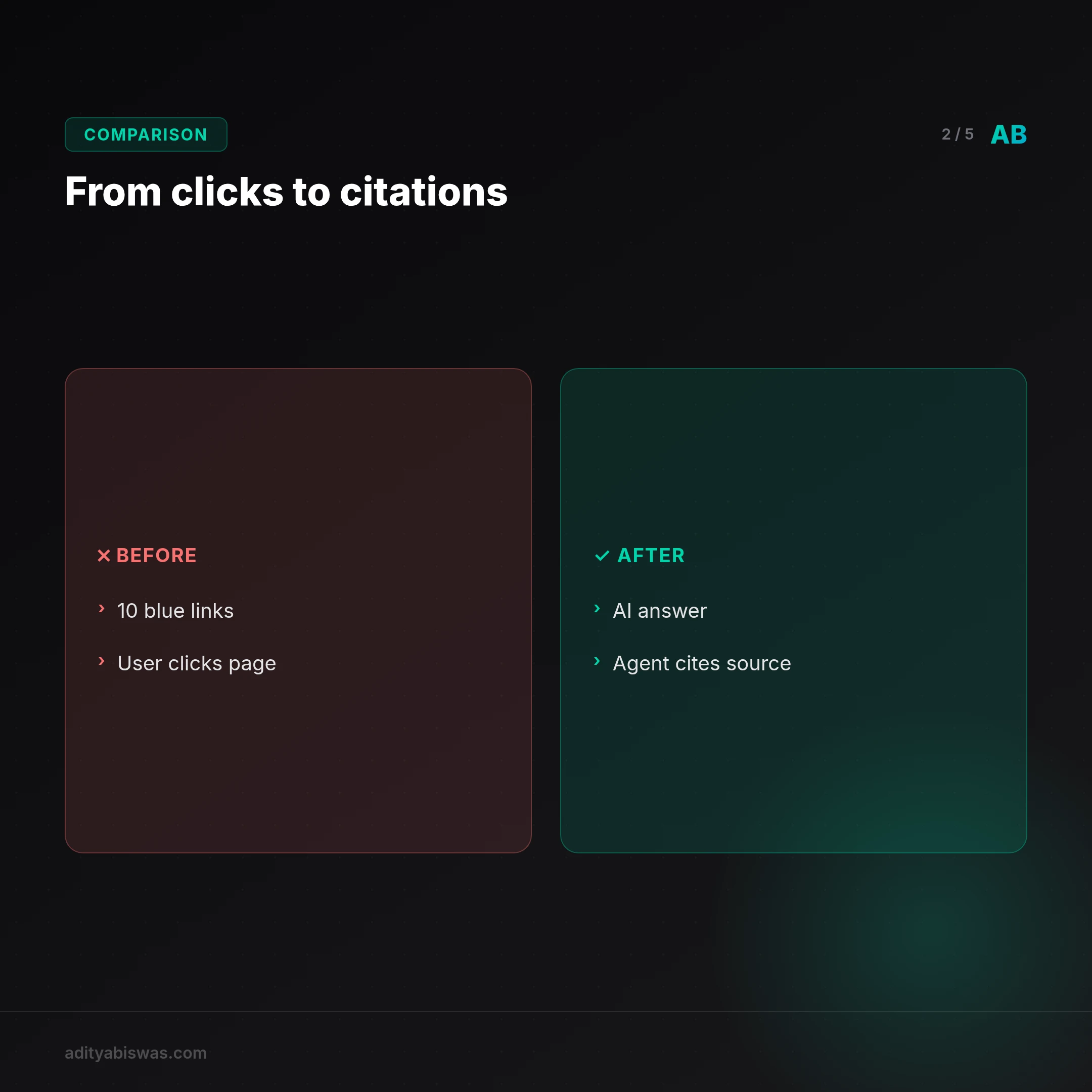
Remember the old rhythm of SEO? Craft a blog post, work in the keywords, build some backlinks, and hope for a spot in the "10 blue links." Search, click, read.
That era is fading fast. AI models like Perplexity, Claude, and Google's own SGE aren't search engines anymore in the old sense; they're answer engines that synthesize information rather than list links. For a solo builder, adapting to that shift isn't optional. It's close to existential.
From 10 blue links to algorithmic synthesis
The old model ran on discovery leading to a click, with your website as the destination. The new model, driven by AI agents, works differently. An agent like Perplexity receives a query, then reads and understands hundreds or thousands of relevant articles across the web instead of matching keywords. It distills the core information, pulling facts, arguments, and counter-arguments from multiple sources at once, and presents a concise answer directly to the user, often without a single click on any link. Crucially, it cites the sources it drew from.
That's the real change. Content isn't competing for a click anymore. It's competing to be consumed, understood, and cited by an agent, and content an agent can't easily digest simply doesn't make it into the synthesis.
DOM bloat vs. Markdown purity
Before the rules: the technical foundation matters first. AI agents are efficient information gatherers with no patience for battling a bloated, poorly structured page.
The DOM, a browser's internal representation of a page, grows with every <div>, <span>, line of CSS, and script on it. A bloated DOM is a house with too many unnecessary walls and hidden passages: slow to load, hard to parse, a real obstacle for an agent trying to pull information out efficiently. Complex page builders, excessive animation, and deeply nested HTML all add to that weight.
Markdown, or clean semantic HTML close to it, is the opposite: a lightweight format that's simple, structured, and easy for a machine to read. Converted to HTML, it produces clean, semantic markup, <h1> for the title, <h2> for subtitles, <ul> for lists, real structure a machine can actually parse.
That matters for agent-SEO on three counts. Clean, lightweight HTML parses faster, so an agent covers more ground and favors content that loads quickly. Semantic HTML makes the role of each piece of content explicit, an <h1> is a heading, a <blockquote> is a quote, which helps an agent understand hierarchy and intent. And less bloat means less noise for the agent to filter through before it finds the actual signal.
For a solo builder this means embracing simplicity: a static site generator, a clean theme, a platform that favors lean code over flourish. The website isn't just for humans reading it anymore. It's a data source for AI too.
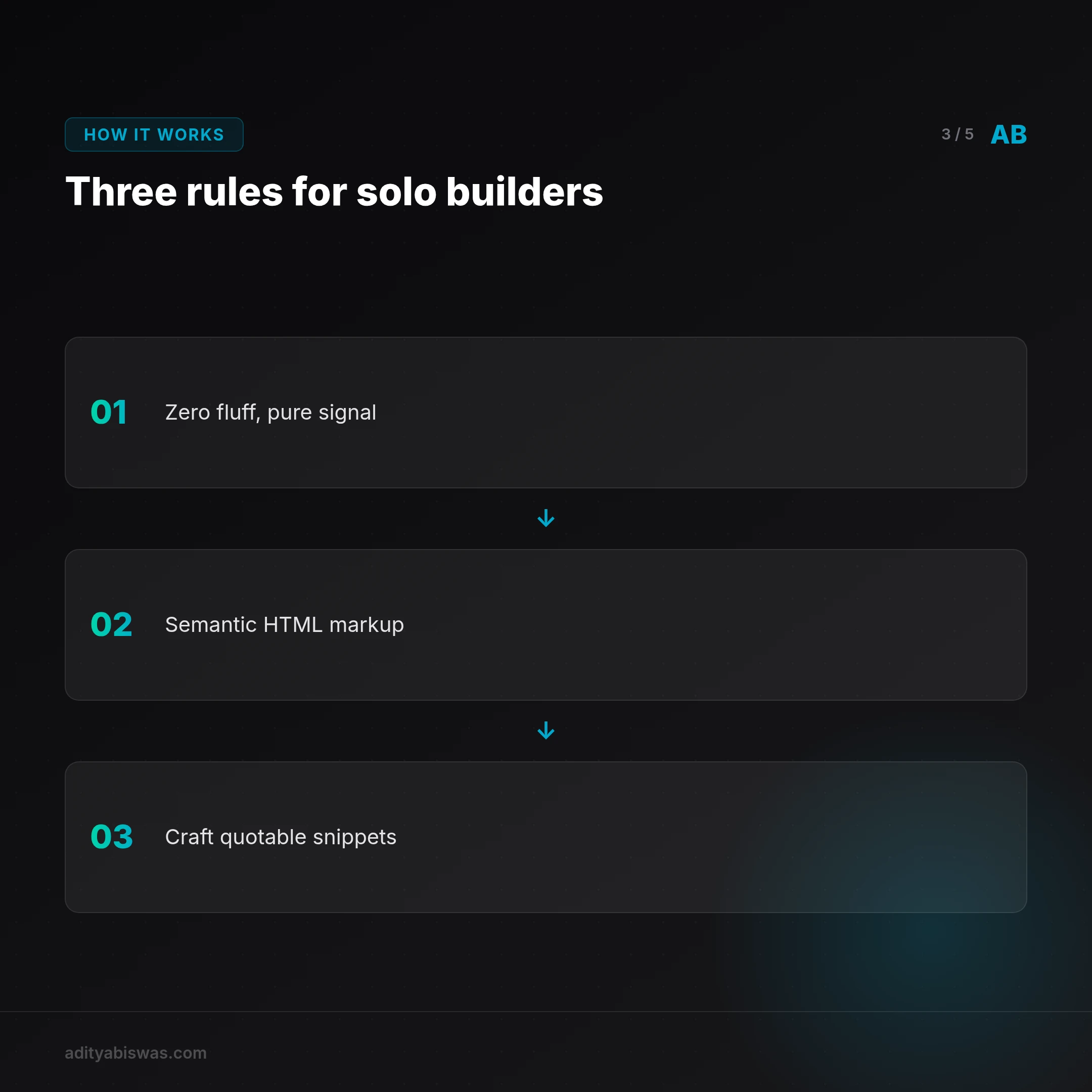
Three rules for solo builders
Zero fluff, pure signal. Agents aren't impressed by a verbose introduction or a paragraph that rehashes the same point twice. They're looking for information density, and every sentence needs to earn its place. Get to the point, answer the question directly, and cut whatever doesn't advance the argument. Diluted content gets skipped in favor of something more concise. After drafting, edit ruthlessly: could this sentence be shorter, could this paragraph become a single line, is every word actually earning its keep.
Semantic formatting is the agent's best friend. This follows directly from the DOM bloat problem. Use HTML elements for what they actually mean: an <h1> for the title, <h2> for major sections, <p> for paragraphs, <blockquote> for an actual quote, not a <div> styled to look like one. Semantic markup works like an organized table of contents for an agent: this is a main point, this is a sub-point, this is a direct quote. That clarity is what lets it parse structure and pull information with any precision. Before publishing, check that the HTML structure actually reflects the hierarchy of the ideas, not just how the page happens to render.
Craft quotable snippets. This might be the highest-leverage rule for direct attribution. Agents don't just summarize; they often quote directly from a source to back up an answer, so make the quote easy to lift. Write concise, self-contained sentences that carry a real insight, a definition, or a conclusion on their own, without needing the surrounding paragraph for context. Content built this way is far more likely to get quoted verbatim and attributed back to the source, which is high-value visibility that shows up right inside the agent's synthesized answer. Place the sharpest insights right after a heading, where an agent is most likely to find and lift them.
Content discovery has genuinely changed. The future isn't just clickable. It's extractable, and for a solo builder that's an opportunity more than a threat. Clean code, dense value, real semantic structure, and quotable insight together position content to be not just found, but actually understood and cited by the agents now shaping how information gets discovered.
References

Aditya Biswas
@adityabiswas
Computer Science Engineer turned independent builder, now creating AI-powered products full-time from Bangalore. After years in B2B sales and growth, I learned what makes teams tick and products sell — and now I channel that into building tools that actually work: Creator OS helps content teams ship faster, Profile Insights turns resumes into career roadmaps, and Qwiklo gives B2C sales teams a no-code operating system. The twist? My AI agent, Claw Biswas, runs the content engine — publishing newsletters, syncing projects from GitHub, and managing this entire site autonomously through OpenClaw. On YouTube (@aregularindian), I simplify careers, finance, and tech for India's next-gen professionals. No fluff, no shady pitches — just clarity. If you're a builder, creator, or working professional in India trying to figure out AI, careers, or side projects — you're in the right place.