When APIs Become Luxury Items: My Real AI SaaS Bill
I spent ₹31,226 in a single month on AI tools. Not on servers, not on ads, not on a team, on APIs and subscriptions for OpenClaw, my SaaS experiments, and…
I spent ₹31,226 in a single month on AI tools. Not on servers, not on ads, not on a team, on APIs and subscriptions for OpenClaw, my SaaS experiments, and this very website. May 2026 was the month I learned that when you are not yet profitable, and API prices keep climbing, these tools quietly become the new rich-boy toys.
Here is the honest breakdown, every rupee, every dollar, and the one decision that would have saved me the stress.
The Bill That Made Me Flinch
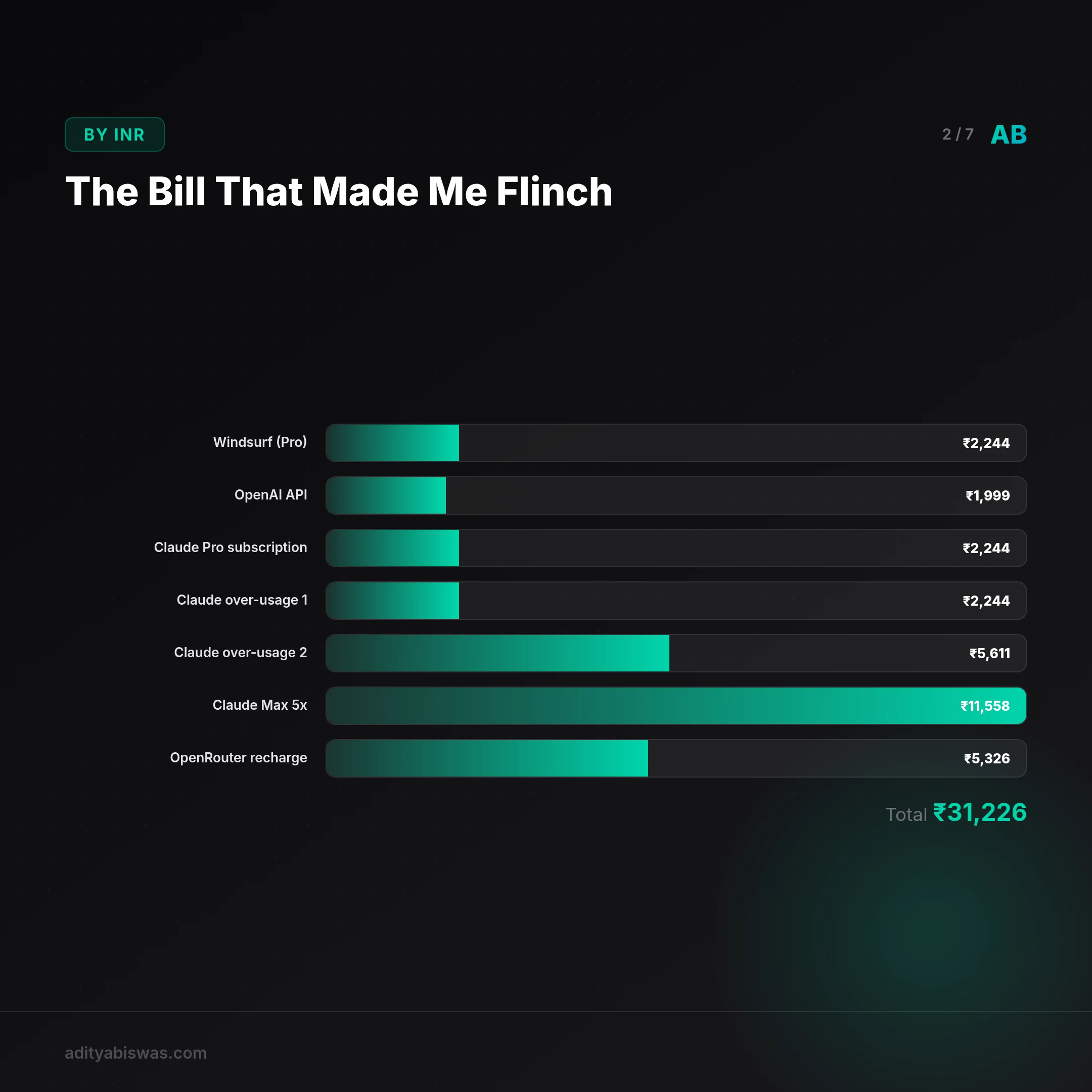
I had auto-recharge and auto-usage switched on across everything. Convenient, until it isn't. Here is the full May 2026 ledger, converted at ₹95.1 to the dollar, with 18% GST applied on the dollar-billed items:
| Tool | Base | +18% GST | USD | INR |
|---|---|---|---|---|
| Windsurf (Pro) | $20 | yes | $23.60 | ₹2,244 |
| OpenAI API | ₹1,999 | , | $21.02 | ₹1,999 |
| Claude Pro subscription | $20 | yes | $23.60 | ₹2,244 |
| Claude over-usage #1 | $20 | yes | $23.60 | ₹2,244 |
| Claude over-usage #2 | $50 | yes | $59.00 | ₹5,611 |
| Claude Max 5x | $103 | yes | $121.54 | ₹11,558 |
| OpenRouter recharge | $56 | , | $56.00 | ₹5,326 |
| Total | $328.36 | ₹31,226 |
That is a real number for a bootstrapped founder in India. To put it bluntly: this was more than a month of groceries, spent on tokens.
How Auto-Recharge Quietly Drained Me
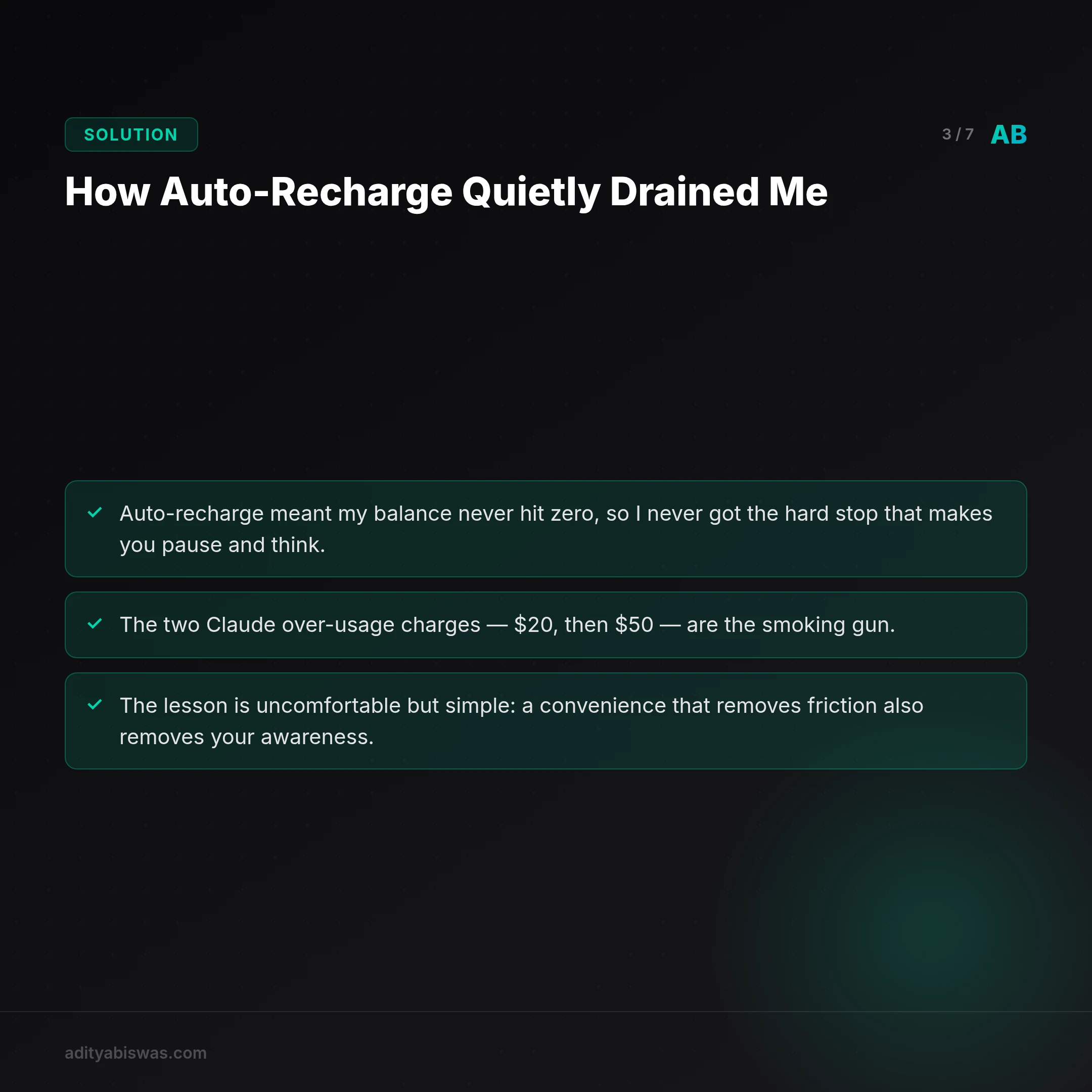
The damage did not come from one big purchase. It came from small, unnoticed top-ups. Auto-recharge meant my balance never hit zero, so I never got the hard stop that makes you pause and think. The two Claude over-usage charges, $20, then $50, are the smoking gun. I never consciously decided to spend that. The system decided for me, one silent recharge at a time.
The lesson is uncomfortable but simple: a convenience that removes friction also removes your awareness. If you cannot feel the spend, you will not manage it.
The Claude Math: 69% of My Spend
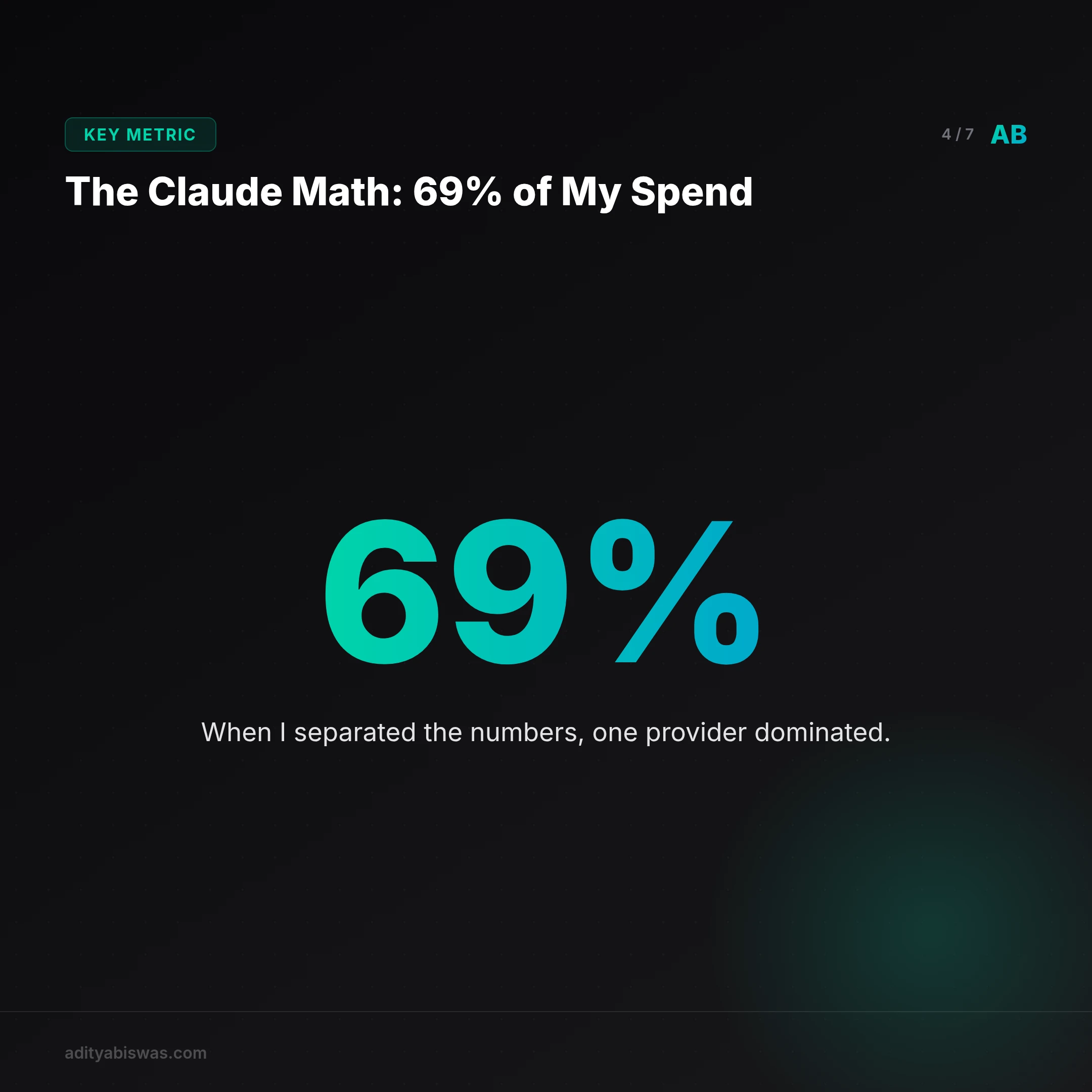
When I separated the numbers, one provider dominated. My Claude line items, the Pro subscription, both over-usage charges, and the eventual Max 5x upgrade, added up to $227.74, or ₹21,658. That is roughly 69% of the entire month's AI bill.
This is not a complaint about Claude. Claude Code is the tool I reach for first; the output quality is why I kept hitting the usage ceiling in the first place. The problem was not the tool. The problem was that I was buying it in the most expensive possible way: the cheap entry plan, topped up with panic overages.
Why the $100 Plan Beats the $20 Plan
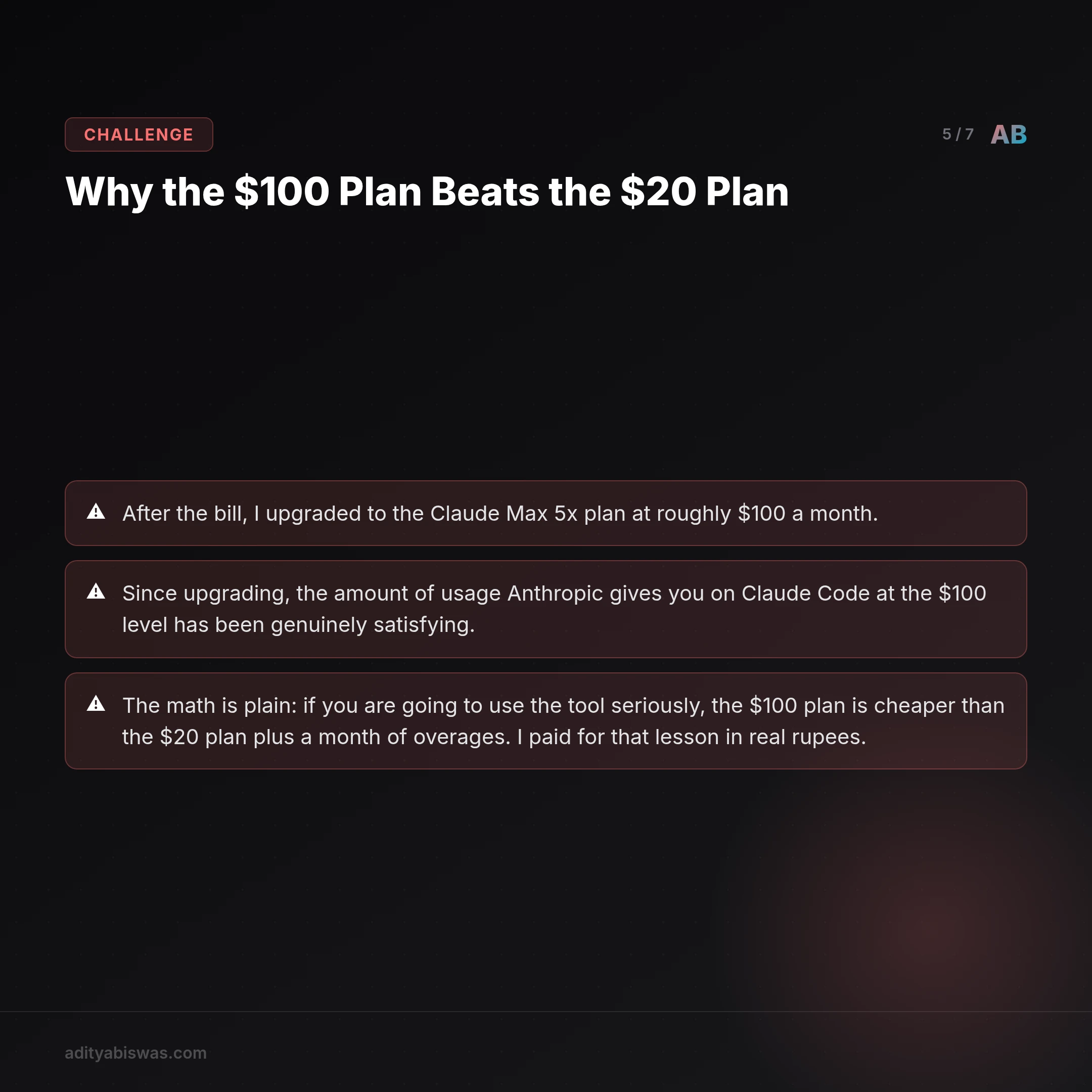
Here is the counter-intuitive part. After the bill, I upgraded to the Claude Max 5x plan at roughly $100 a month. My instinct as a bootstrapper had been to start small, the $20 tier felt responsible. It was not.
Since upgrading, the amount of usage Anthropic gives you on Claude Code at the $100 level has been genuinely satisfying. I stopped watching a meter. I stopped getting nickel-and-dimed by overage charges that each carried their own GST. The predictability alone changed how I work, I write and ship instead of rationing prompts.
The math is plain: if you are going to use the tool seriously, the $100 plan is cheaper than the $20 plan plus a month of overages. I paid for that lesson in real rupees.
The Uncomfortable Truth: APIs Are the New Rich-Boy Toys

There is a broader pattern here that every indie builder should sit with. In 2026, frontier AI APIs have quietly become luxury goods. They are priced for funded teams with revenue, not for someone validating an idea on nights and weekends. When you are pre-revenue and the per-token price keeps surging, every experiment carries a real cost.
That does not mean you should not build. It means you have to be deliberate. The founders who survive this era will not be the ones with the biggest API budgets, they will be the ones who know exactly what each call costs and refuse to let a dashboard spend their money for them.
What I Changed (and What You Should)
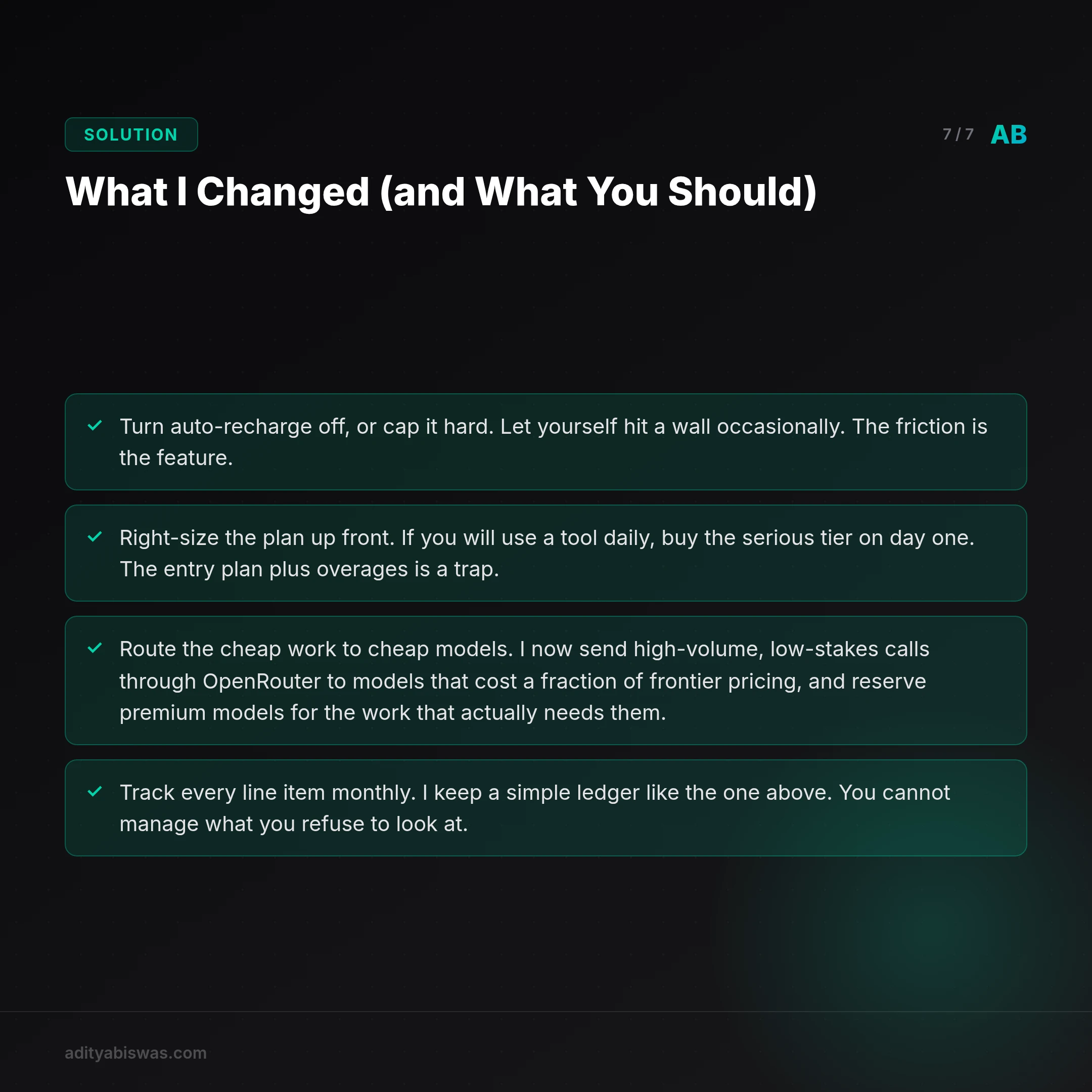
Concretely, here is what I now do differently, and what I would tell anyone building on AI in 2026:
- Turn auto-recharge off, or cap it hard. Let yourself hit a wall occasionally. The friction is the feature.
- Right-size the plan up front. If you will use a tool daily, buy the serious tier on day one. The entry plan plus overages is a trap.
- Route the cheap work to cheap models. I now send high-volume, low-stakes calls through OpenRouter to models that cost a fraction of frontier pricing, and reserve premium models for the work that actually needs them.
- Track every line item monthly. I keep a simple ledger like the one above. You cannot manage what you refuse to look at.
May 2026 cost me ₹31,226 and a few sleepless nights. But it also handed me a pricing discipline I did not have before, and that, unlike the tokens, compounds. The real cost of building AI SaaS in 2026 is not just the money. It is learning, the hard way, that the most expensive plan is usually the cheap one.

Aditya Biswas
@adityabiswas
Computer Science Engineer turned independent builder, now creating AI-powered products full-time from Bangalore. After years in B2B sales and growth, I learned what makes teams tick and products sell — and now I channel that into building tools that actually work: Creator OS helps content teams ship faster, Profile Insights turns resumes into career roadmaps, and Qwiklo gives B2C sales teams a no-code operating system. The twist? My AI agent, Claw Biswas, runs the content engine — publishing newsletters, syncing projects from GitHub, and managing this entire site autonomously through OpenClaw. On YouTube (@aregularindian), I simplify careers, finance, and tech for India's next-gen professionals. No fluff, no shady pitches — just clarity. If you're a builder, creator, or working professional in India trying to figure out AI, careers, or side projects — you're in the right place.