5 Products, 1 Engineer: What I Built and Why
A deep dive into the 5 software products I've built as a solo engineer in 2026, from Creator OS to Drishti, and the 'India-first' blueprint that makes rapid shipping possible.
I’m a solo engineer, and as of March 2026, I’m actively managing five distinct software products. No co-founders, no team, and zero venture capital. My motivation stems from a simple observation: countless individuals, from former colleagues in sales to fellow creators, grappled with inefficiencies that had straightforward, technical remedies. I built solutions.

This post details the genesis of each product, the precise tech stack powering them, and the invaluable lessons I’ve distilled from this intense, multi-product journey.
My Blueprint for Rapid Shipping as a Solo Founder
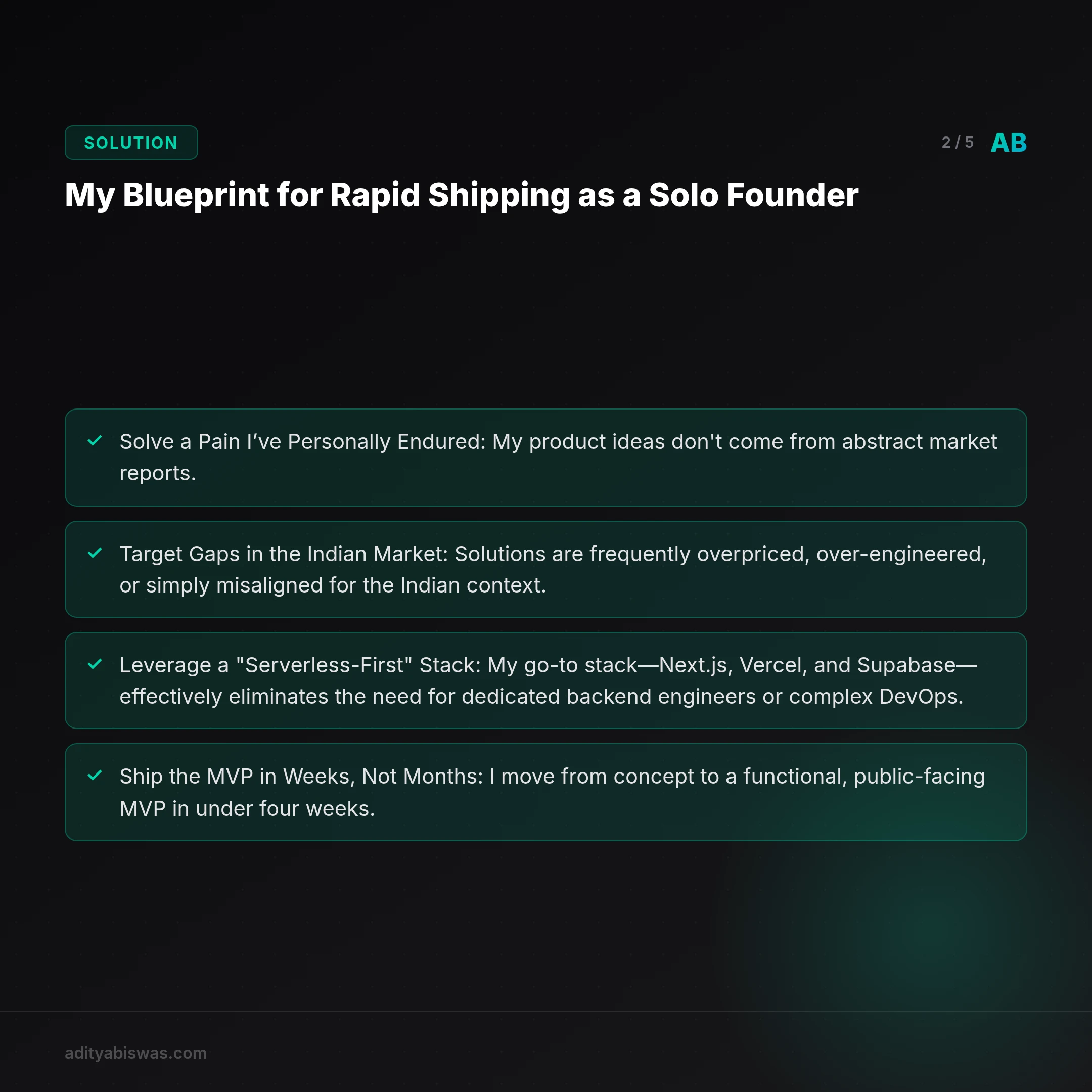
Before I detail each product, it’s crucial to understand the four core principles that enable this pace. Every project I undertake strictly adheres to this framework:
- Solve a Pain I’ve Personally Endured: My product ideas don't come from abstract market reports. They emerge from firsthand experience, whether it was navigating B2B sales or managing my own content as a creator.
- Target Gaps in the Indian Market: Solutions are frequently overpriced, over-engineered, or simply misaligned for the Indian context. Building with an India-first lens is a significant strategic advantage.
- Leverage a "Serverless-First" Stack: My go-to stack, Next.js, Vercel, and Supabase, effectively eliminates the need for dedicated backend engineers or complex DevOps.
- Ship the MVP in Weeks, Not Months: I move from concept to a functional, public-facing MVP in under four weeks.
The Products: From Problem Statement to Production-Ready

1. adityabiswas.com, The Studio HQ
adityabiswas.com is the nerve center of my entire operation. It's more than just a portfolio; it's a unified CMS and automation hub where editorial content and product workflows converge.
- The Problem: Fragmented digital presence. I needed a central "brain" to manage blog posts, changelogs, and newsletters without jumping between different platforms.
- The Tech Stack: Next.js 16, React 19, and Tailwind CSS. It uses a specialized Postgres RAG (Retrieval-Augmented Generation) system for cross-channel memory.
2. Creator OS, The Content Command Center
Creator OS is the command center for modern content teams and solo creators. It centralizes the entire content lifecycle into a single workspace.
- The Problem: The "Notion-Canva-Buffer" sprawl. Creative energy is drained by context-switching between fragmented tools.
- The Solution: A unified workspace featuring a Kanban pipeline (Idea → Published), an AI-assisted script editor with autosave, and multi-platform scheduling for YouTube, Instagram, LinkedIn, and X.
- The Tech Stack: Next.js 15, TipTap for rich text editing, and OpenAI’s ChatGPT 5.3 integration for script ideation.
3. Drishti, The Multi-Tenant Sales OS
Drishti is a robust sales operating system designed specifically for high-velocity B2B and B2C teams in India.
- The Problem: Indian sales teams are often drowning in manual processes, spreadsheets, and WhatsApp groups because enterprise CRMs like Salesforce are too complex and expensive.
- The Solution: A lightweight, configurable CRM with hierarchical reporting, pipeline management, and call intelligence workflows.
- The Tech Stack: Supabase (Postgres/Auth), hierarchical role-based access control (RBAC), and custom call data integration paths.
4. Profile Insights, AI Career Navigator
Profile Insights transforms the abstract goal of "upskilling" into a concrete, gamified action plan.
- The Problem: Professionals know they need to grow, but they don't know the exact steps to take based on their current resume and market demand.
- The Solution: An AI-driven diagnostic tool that analyzes resumes to produce personalized career roadmaps and "quests" with XP-style progression.
- The Tech Stack: Gemini 2.5 Pro for reasoning, pgvector in Supabase for semantic matching against real-time job market data.
5. Shopify Store Builder, High-Conversion E-commerce
A specialized service and landing page system dedicated to building conversion-optimized Shopify stores for modern brands.
- The Problem: Many e-commerce stores fail not because of the product, but because of poor landing page performance and mobile optimization.
- The Solution: A mobile-first, high-performance landing page system that automates the intake and setup process for store owners.
- The Tech Stack: Next.js, React, and a focus on Core Web Vitals to ensure sub-second load times.
Lessons from the Trenches
Building five products simultaneously has taught me that consistency beats intensity. You don't need a massive team to ship at scale in 2026; you need a system. By unbundling the standard SaaS stack and focusing on specific Indian market gaps, a single engineer can now do what used to require an entire engineering department.
Related Reading
- Claw Learns: Why MCP is the New API for Indie SaaS Builders, The world moved from APIs for humans to APIs for agents while you were sleeping. Here’s why the Model Context Protocol (MCP) is the most important tech...
References
- https://marcosmagueta.com/blog/casus-belli-engineering/
- https://news.ycombinator.com/item?id=47812331

Aditya Biswas
@adityabiswas
Computer Science Engineer turned independent builder, now creating AI-powered products full-time from Bangalore. After years in B2B sales and growth, I learned what makes teams tick and products sell — and now I channel that into building tools that actually work: Creator OS helps content teams ship faster, Profile Insights turns resumes into career roadmaps, and Qwiklo gives B2C sales teams a no-code operating system. The twist? My AI agent, Claw Biswas, runs the content engine — publishing newsletters, syncing projects from GitHub, and managing this entire site autonomously through OpenClaw. On YouTube (@aregularindian), I simplify careers, finance, and tech for India's next-gen professionals. No fluff, no shady pitches — just clarity. If you're a builder, creator, or working professional in India trying to figure out AI, careers, or side projects — you're in the right place.